Russula paludosaBritzelm.
Phylum: Basidiomycota - Class: Agaricomycetes - Order: Russulales - Family: Russulaceae
Distribution - Taxonomic History - Etymology - Identification - Culinary Notes - Reference Sources
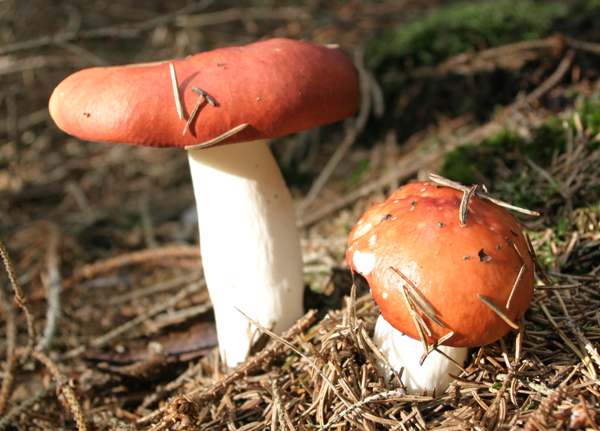
Despite being easily mistaken for the poisonous Sickener and growing in the same habitat – coniferous woodland – Russula paludosa is a popular edible mushroom in Scandinavia, where it is very common in spruce plantations.
The specific epithet paludosa suggests an association with boggy land, and indeed this brittlegill often does occur under conifers (especially pines) in peaty, boggy areas... but by no means always so.
Distribution
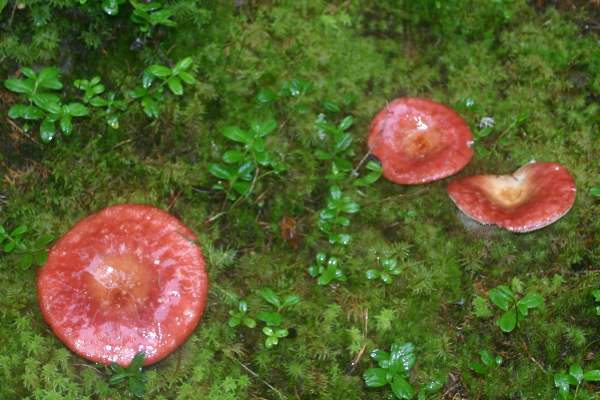
In Britain this pretty brittlegill is an occasional find in the uplands of Scotland, while reports of it being sighted in England, Wales or Ireland are very few and far between. Russula paludosa is quite common in Scadinavia, and its range extends southwards to countries in central Europe. There are reoports of Russula paludosa (or a very similar species under the same name) occuring in parts of North America.
Taxonomic history
This brittlegill mushrooml was described in 1890 by German mycologist Max Britzelmayr (1839 - 1909), who established its currently-accepted scientific name Russula paludosa.
Synonyms of Russula paludosa include Russula elatior Lindbl., Russula fragaria Kudrna, Russula integra var. paludosa (Britzelm.) Singer, and Russula olgae Velen.
Etymology
Russula, the generic name, means red or reddish, and indeed many of the brittlegills have red caps (but many more are not, and several of those that are usually red can also occur in a range of other colours!).
The specific epithet paludosa means of bogs, swamps or marshes - a reference to the damp mossy woodland habitats in which these colourful brittlegill mushrooms are most often found.
Identification guide
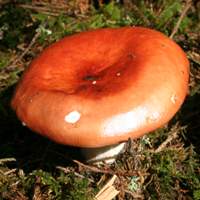 |
CapRed, purplish bay brown or ochre; occasionally with pale patches; peeling 1/2 to centre; cap flesh is pink just beneath cuticle; hemispherical then convex, becoming flat with a central depression; margin becoming striate; 5 to 15cm across. |
GillsCream, turning light ochre; adnexed; crowded. StemWhite; cylindrical, occasionally swollen in centre or with a slightly clavate base; 4 to 15cm long (for a brittlegill this is exceptionally long relative to its cap diameter), 1 to 3cm diameter. |
|
SporesBroadly ellipsoidal to globose; 8-10.5 x 7-8μm, with large warts up to 1.2μm tall, some of which are joined by connecting lines forming a very partial reticulate network. Spore printDeep cream to dark ochre. |
|
Odour/taste |
Not distinctive. |
Habitat & Ecological role |
Damp mossy conifer forests. In common with other members of the Russulaceae, Russula paludosa is an ectomycorrhizal mushroom. |
Season |
August to October in Britain and Ireland. |
Similar species |
The Beechwood Sickener, Russula nobilis, is is found under conifers; it is similar to red specimens of Russula paludosa when caps are young but caps remain convex rather than becoming depressed when fully mature. |
Culinary Notes
This is a rare mushroom, at least in Britain and Ireland, and so when gathering mushrooms for food Russula paludosa should not be picked. In Scandinavia this brittlegill is considered a good edible species, but care is necessary as it is easily confused with poisonous red-capped mushrooms such as the Sickener Russula emetica which often occur in the same kinds of woodland habitats.
Reference Sources
Pat O'Reilly (2016). Fascinated by Fungi, First Nature Publishing
Geoffrey Kibby (2011).The Genus Russula in Great Britain, published by G Kibby.
Roberto Galli (1996). Le Russule. Edinatura, Milan.
Paul M. Kirk, Paul F. Cannon, David W. Minter and J. A. Stalpers. (2008). Dictionary of the Fungi; CABI.
Taxonomic history and synonym information on these pages is drawn from many sources but in particular from the British Mycological Society's GB Checklist of Fungi.
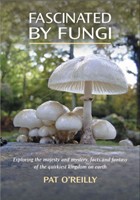
Fascinated by Fungi. Back by popular demand, Pat O'Reilly's best-selling 450-page hardback book is available now. The latest second edition was republished with a sparkling new cover design in September 2022 by Coch-y-Bonddu Books. Full details and copies are available from the publisher's online bookshop...