
Russula rosea Pers. - Rosy Brittlegill
Phylum: Basidiomycota - Class: Agaricomycetes - Order: Russulales - Family: Russulaceae
Distribution - Taxonomic History - Etymology - Culinary Notes - Identification - Reference Sources
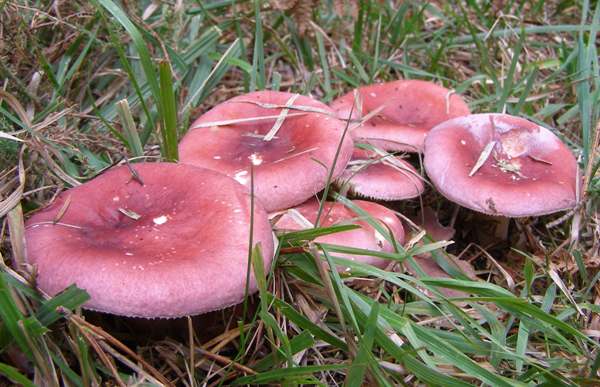
This beautiful mushroom is often confused with other reddish brittlegills. Brittlegills can be difficult to separate without resorting the chemical tests and microscopy, and identifying the Rosy Brittlegill is not helped by the fact that the stems are not always flushed with a carmine red.
Distribution
This is an uncommon but nevertheless widespread mushroom of broadleaf woodland-edges in Britain, Ireland and many parts of mainland Europe.
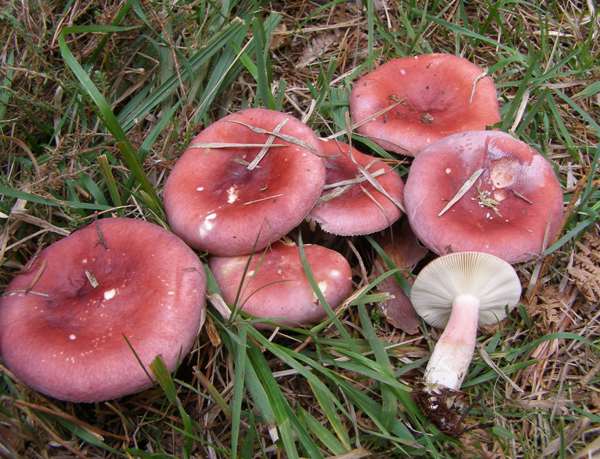
Although an infrequent find, the Rosy Brittlegill usually makes up for it by being gregarious and producing spectacular displays of long-lasting (compared with many other fungi genera) colourful fruitbodies.
Taxonomic history
The Rosy Brittlegill was described and given its currently-accepted scientific binomial name in 1796 by Christiaan Hendrik Persoon. Come confusion arises because in 1886 Lucien Quélet described another brittlegill and named it Russula rosea; however, that reddish-capped species and now recognised as synonymous with Russula aurora (Krombh.) Bres.
Synonyms of Russula rosea include Russula lepida var. lactea (Pers.) F.H. Møller & Jul. Schäff., Agaricus lacteus Pers., Russula lepida Fr., Russula lactea (Pers.) Fr., Russula linnaei, and Russula lepida var. alba Quél.
Etymology
Russula, the generic name, means red or reddish, and indeed many of the brittlegills have red caps (but many more are not red, and several of those that are usually red can also occur in a range of other colours!). The specific epithet rosea means rosy red, of course.
Identification guide
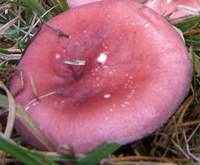 |
CapRed or pink, often cream towards the centre; sometimes entirely cream; dry, either shiny or matt, sometimes slightly powdered. 5 to 12cm diameter, convex, later flattening or developng a slight central depression. Peeling minimally or not at all. |
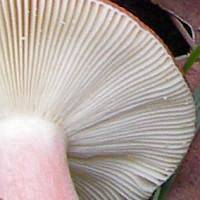 |
GillsPale cream, almost free; forked; very brittle. StemSolid and difficult to squash; brittle white flesh; surface usually but not always flushed carmine, especially in upper part; cylindrical, often slightly swollen in lower part; 4 to 10cm long, 1 to 2cm diameter. |
SporesOvoid; 7-9 x 6.4-7.4µm; with warts up to 0.5µm tall, connected to form a complete or near-complete reticulum (mesh-like network). Spore printPale cream. |
|
Odour/taste |
Odour pleasant but not distinctive; taste mild but variable - usually reminiscent of cedarwood pencils or turpentine, but sometimes slightly bitter. |
Habitat & Ecological role |
Mycorrhizal with deciduous broadleaf trees, particularly Beech, but occasionally also found under conifers. |
Season |
August to October in Britain and Ireland. |
Similar species |
The Beechwood Sickener Russula nobilis is also found under broadleaf trees, and in particular Beech trees; in appearance it is very similar to red specimens of Russula rosea but its stem is not flushed carmine. |
Culinary Notes
Russula rosea is quoted by some authorities as inedible but by others as being edible; however, great care is neccesary to ensure that the Rosy Brittlegill is not confused with any of the poisonous red-capped brittlegills such as Russula emetica and Russula nobilis.
Reference Sources
Pat O'Reilly (2016). Fascinated by Fungi, First Nature Publishing
Geoffrey Kibby (2011).The Genus Russula in Great Britain, published by G Kibby.
Roberto Galli (1996). Le Russule. Edinatura, Milan.
Paul M. Kirk, Paul F. Cannon, David W. Minter and J. A. Stalpers. (2008). Dictionary of the Fungi; CABI.
Taxonomic history and synonym information on these pages is drawn from many sources but in particular from the British Mycological Society's GB Checklist of Fungi.
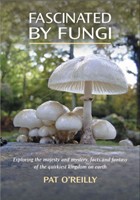
Fascinated by Fungi. Back by popular demand, Pat O'Reilly's best-selling 450-page hardback book is available now. The latest second edition was republished with a sparkling new cover design in September 2022 by Coch-y-Bonddu Books. Full details and copies are available from the publisher's online bookshop...