
Asterophora parasitica (Bull.) Singer - Silky Piggyback
Phylum: Basidiomycota - Class: Agaricomycetes - Order: Agaricales - Family: Lyophyllaceae
Distribution - Taxonomic History - Etymology - Identification - Toxicity - Reference Sources
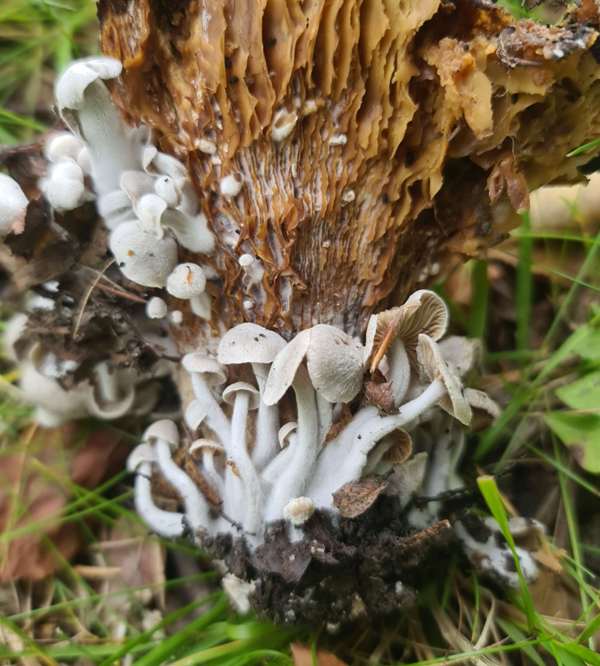
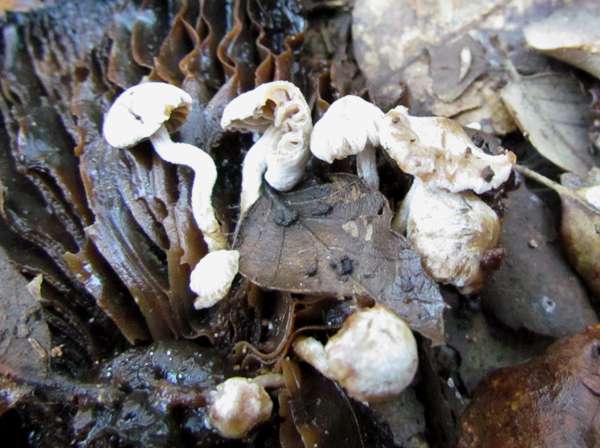
The Silky Piggyback Asterophora parasitica, pictured above, is very similar to Asterophora lycoperdoides, the Powdery Piggyback, but its cap is covered in fine radial fibrils; this gives it a silky appearance.
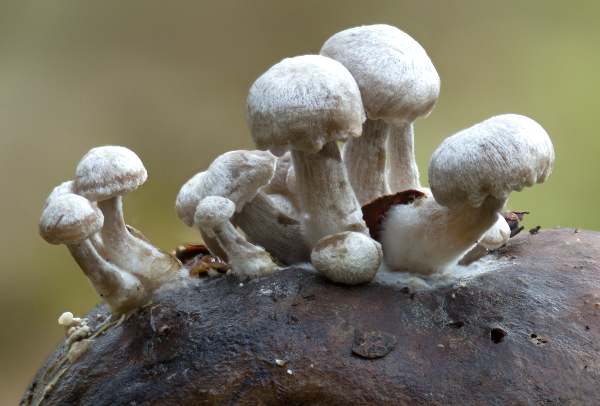
Unlike the Powdery Piggyback the gills of this little white mushroom, on which white chlamydospores develop along with basidiospores, are fully formed. The cap expands until it is broadly concave or almost flat.
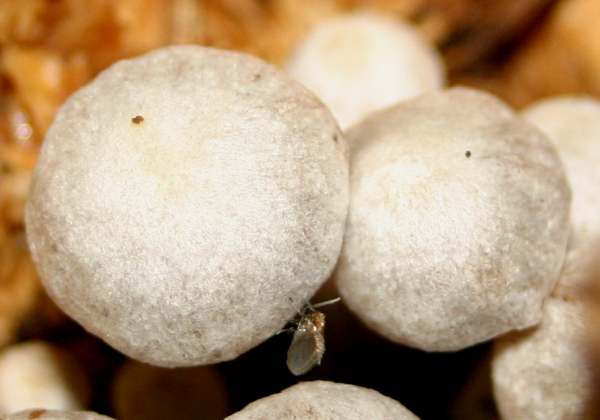
The Silky Piggyback is seen most often on Russula nigricans, Russula densifolia, Russula fellea and Russula foetens; but there are also a few reports of it being found on the decaying caps of certain kinds of milkcaps (Lactarius species).
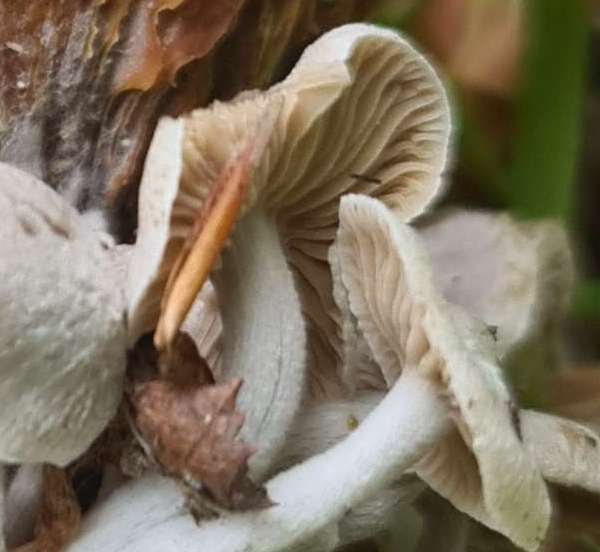
Only when you look very closely at the caps of these tiny mushrooms can you see the very fine fibres that give a silky feel to the surface (above); it is this feature which has given rise to the common English name Silky Piggyback.
Distribution
Almost certainly widespread and common throughout Britain and Ireland, but less commonly noticed because of its diminutive size and its habit of fruiting in decaying fungi that themselves are unlikely to grab the attention, the Silky Piggyback is found also in many parts of mainland Europe and in North America.
Taxonomic history
This species was first described in 1792 by the French mycologist Jean Baptiste Francois (Pierre) Bulliard, who gave it the scientific name Agaricus parasiticus. (Most gilled fungi were initially placed in a giant Agaricus genus, now redistributed to many other genera.) It was German-born mycologist Rolf Singer who, in 1949, transferred this species to its present genus, establishing the currently-accepted scientific name as Asterophora parasitica.
Synonyms of Asterophora parasitica include Agaricus parasiticus Bull., Agaricus umbratus With., Gymnopus parasiticus (Bull.) Gray, and Nyctalis parasitica (Bull.) Fr.
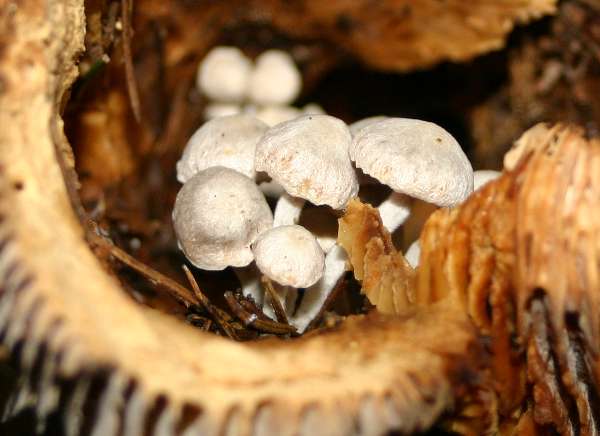
The Silky Piggyback mushrooms shown above were seen nestling between the decaying gills of an old brittlegill mushroom in southern Portugal.
Etymology
Asterophora comes from the Greek words "a'ster" (meaning star) and "phor-" a form of "phero" (meaning to bear or carry) - hence bearing stars, or starry. The coarsely verrucose to blunty spinose chlamydospores do indeed appear to be bearing stars on their surfaces.
The specific epithet parasitica reflects the fact that this little mushroom feeds on the decaying fruitbodies of other larger fungi, although whether it can truly be considered a parasite is questionable.
Toxicity
These tiny and insubstantial mushrooms are generally reported to be inedible. It is unclear whether they contain any very dangerous toxins, but they should certainly not be collected during fungi forages for food.
Identification guide
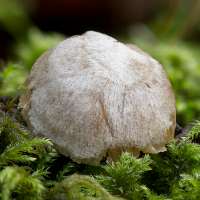 |
Cap0.5 to 2cm across; globose or convex; white; covered in silky radial fibrils; increasingly covered in fine powdery chlamydospores. |
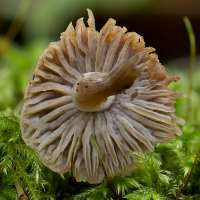 |
GillsInitially white or very pale grey, turning brownish; adnate; thick and distant. Stem1 to 3cm long and 2 to 4mm diameter; white, browning with age; surface finely woolly; nearly always curved; no stem ring. |
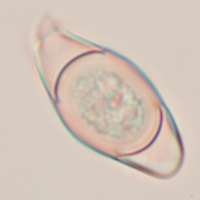
ChlamydosporesPale brown, subfusiform, smooth,12-17 x 9-10µm; forming on the gills rather than on the cap surface (as they do on the caps of the otherwise quite similar Asterophora lycoperdoides). Show larger imageChlamydospores of Asterophora parasitica, Silky Piggyback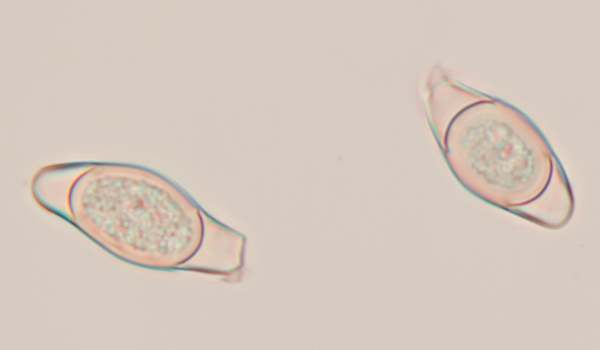 |
|
BasidiosporesBroadly ovoid, smooth, 5-6 x 3-4µm. Spore printWhite. |
|
Odour/taste |
Not significant. |
Habitat & Ecological role |
Saprobic, on various types of decaying brittlegill fruitbodies, particularly the large blackening species Russula nigricans and Russula densifolia. |
Season |
Most plentiful in Britain and Ireland from September to November. |
Similar species |
Asterophora lycoperdoides has a granular cap and rarely has well-formed gills. |
Reference Sources
Fascinated by Fungi, 2nd Edition, Pat O'Reilly 2016, reprinted by Coch-y-bonddu Books in 2022.
Dictionary of the Fungi; Paul M. Kirk, Paul F. Cannon, David W. Minter and J. A. Stalpers; CABI, 2008
Taxonomic history and synonym information on these pages is drawn from many sources but in particular from the British Mycological Society's GB Checklist of Fungi.
Acknowledgement
This page includes pictures kindly contributed by David Kelly and Brian Niven.
Fascinated by Fungi. Back by popular demand, Pat O'Reilly's best-selling 450-page hardback book is available now. The latest second edition was republished with a sparkling new cover design in September 2022 by Coch-y-Bonddu Books. Full details and copies are available from the publisher's online bookshop...