
Hericium americanum Ginns - Lion's Mane
Phylum: Basidiomycota - Class: Agaricomycetes - Order: Russulales - Family: Hericiaceae
Distribution - Taxonomic History - Etymology - Identification - Culinary Notes - Reference Sources
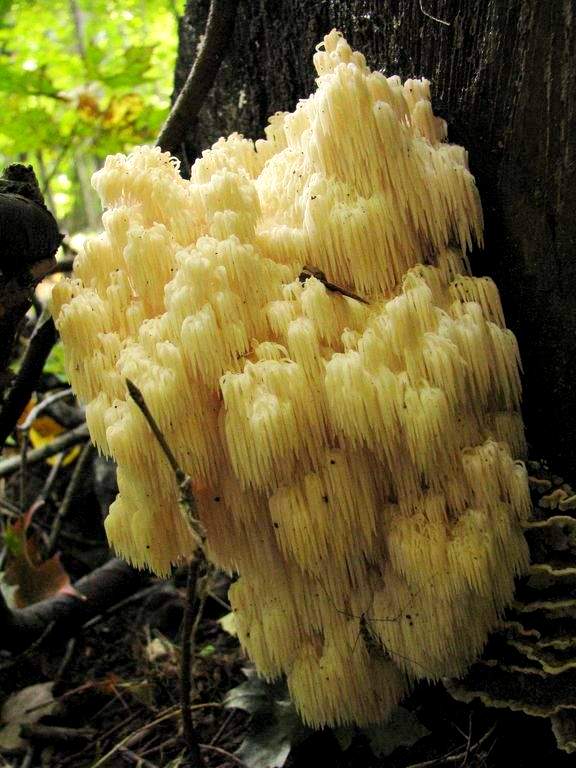
This very beautiful fungus of damaged hardwood trees is rare in the USA and does not occur in Britain and Ireland, although similar species such as Hericium erinaceus are occasionally found in Britsin.
This is an edible species and highly prized, but their rarity is good reason for not collecting any of the Hericiaceae.
The picture shown on the left is Hericium americanum, and the photograph was taken in the USA by Nigel P Kent. We are grateful to Nigel for giving us permission to display this splendid image. (We are still impatiently awaiting our first UK sighting of Hericium erinaceus, and the New Forest is one location where it is known to have occurred in recent years.)
Classification note: Although DNA analysis has confirmed that many tooth fungi (such as the Hedgehog Fungus Hydnum repandum) are properly - Classified in the order Cantharellales, the Lion's Mane is now included in the order Russulales.
Distribution
Not known from Britain and Ireland nor from mainland Europe, this beautiful fungus is found on the eastern side of North America.
This remarkable fungus and other member of the Hericiaceae are distinguished by their icicle-like spines, creating the appearance of a frozen waterfall (or a white lion's mane!).
Taxonomic history
The currently-accepted scientific name of this species, Hericium americanum, dates from a 1984 publication by Canadian mycologist James Herbert Ginns (b. 1938). Hericium coralloides (Fr.) S. F. Gray is considered by some authorities to be a synonym of Hericium americanum; however this is contentious (and very confusing) because Hericium coralloides (Scop.) Pers. is the accepted scientific name of Coral Tooth, another rare European fungus that is found, albeit very rarely, in Britain.
Etymology
Hericium, the generic name, means pertaining to a hedgehog, and is a reference to the spiny fertile surfaces of fungi within this grouping. The specific epithet americanum indicates where this species occurs.
Identification guide
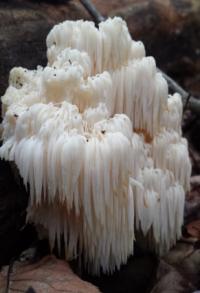 |
FruitbodyA mature fruitbody of Erinaceus americanum usually has several branches. White or pale yellow-brown turning darker with age, the fruitbody is attached to the substrate by a very short, broad stipe. The whole fruitbody can be as big as to 30cm across, although 15 to 20cm is more typical. The beautiful specimen shown on the left was photographed by Josh Doty in Ligonier, Pennsylvania. |
SporesBroadly ellipsoidal to subglobose, smooth or minutely warty, 5-7 x 4.5-6µm; amyloid. Spore printWhite. |
|
Odour/taste |
Not distinctive. |
Habitat & Ecological role |
Saprobic on dead broadleaf trees and on fallen trunks and branches; perhaps initially parasitic on dying broadleaf trees. Very infrequently recorded growing on conifer wood. |
Season |
Late summer and fall (autumn). |
Occurrence |
Hericium americanum is uncommon in the USA and does not occur in Britain and Ireland. |
Similar species |
Hydnum rufescens and Hydnum repandum also have downward-projecting spines, but they are attached to a smooth-topped cap. Hericium erinaceus usually has a rounded fruitbody; it occurs in the USA, particularly in the southern States, and it is also found in Europe, including Britain, where it is very rare. Hericium coralloides is very rare in the UK; it has a rubbery, coral-like branching fruitbody and is usually associated with beech and ash trees. Hericium cirrhatum is also very rare in the UK; it has shorter spines and a much thinner bracket-like tiered fruitbody. |
Culinary Notes
When young and fresh Hericium fungi are generally considered to be choice edibles with a fine flavour and texture similar to fish or tender meat. (In Britain it is illegal to gather any Hericium species, because they have legal protection under Schedule 8 of the Wildlife and Countryside Act 1981 which precludes picking and destruction of the fruitbodies.)
Reference Sources
Fascinated by Fungi, 2nd Edition, Pat O'Reilly 2016, reprinted by Coch-y-bonddu Books in 2022.
Dictionary of the Fungi; Paul M. Kirk, Paul F. Cannon, David W. Minter and J. A. Stalpers; CABI, 2008
Taxonomic history and synonym information on these pages is drawn from many sources but in particular from the British Mycological Society's GB Checklist of Fungi.
Fascinated by Fungi. Back by popular demand, Pat O'Reilly's best-selling 450-page hardback book is available now. The latest second edition was republished with a sparkling new cover design in September 2022 by Coch-y-Bonddu Books. Full details and copies are available from the publisher's online bookshop...