
Hericium erinaceus (Bull.) Pers. - Bearded Tooth
Phylum: Basidiomycota - Class: Agaricomycetes - Order: Russulales - Family: Hericiaceae
Distribution - Taxonomic History - Etymology - Identification - Culinary Notes - Reference Sources
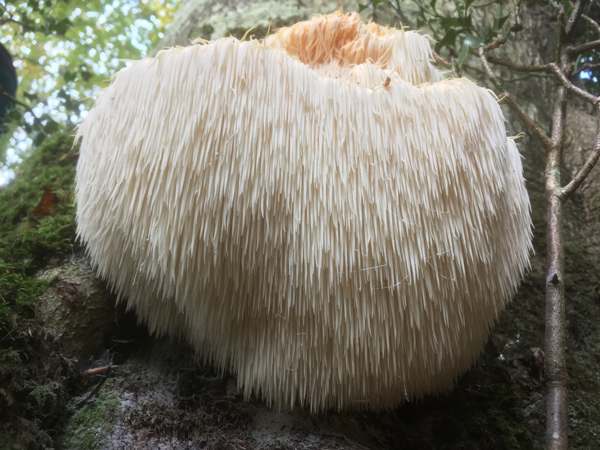
Despite its monochrome colouring, Hericium erinaceus is by any standards one of our most striking of woodland fungi. The fruitbodies appear on damaged or felled trees usually in old (mainly deciduous) woodland.
Unfortunately, Hericium erinaceus (in some field guides it is listed as Hericium erinaceum) which is commonly referred to as Bearded Tooth or Tree Hedgehog fungus, is rare in the UK, where it grows mainly on Beech and oak trees, and is a Biodiversity Action Plan (BAP) species.
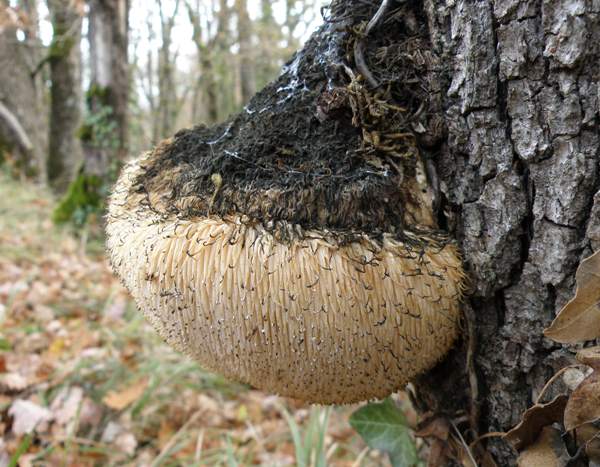
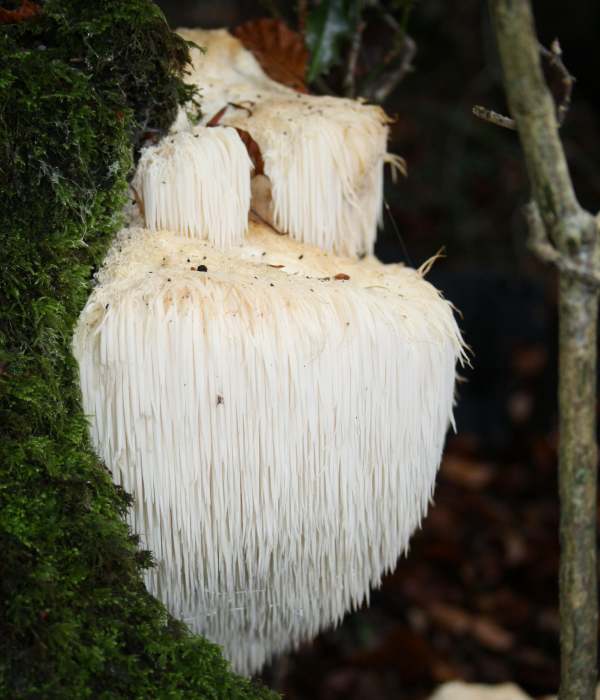
Here is a picture of another fine specimen. We found this one with several others on roadside trees (growing where the bark had been damaged, perhaps by a verge-cutting flail mower) in the Lot Valley, in southern France, a region where these remarkable fungi are fairly common finds.
Classification note
Although DNA analysis has confirmed that many tooth fungi (such as the Hedgehog Fungus Hydnum repandum) are properly - Classified in the order Canthellales, the Bearded Tooth are is not closely related to other tooth fungi and so the Hericiaceae are now included in the order Russulales.
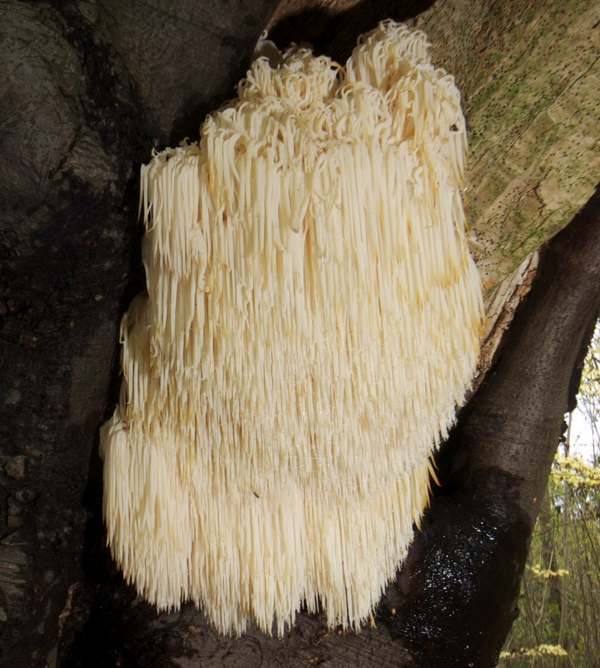
Hericium erinaceus and other member of the Hericiaceae are distinguished by their icicle-like spines, upon the surfaces of which spores are produced. The pendent spine give the impression of a frozen waterfall (or perhaps, reflecting an alternative common name used particularly in North America, the mane of a white lion!).
Distribution
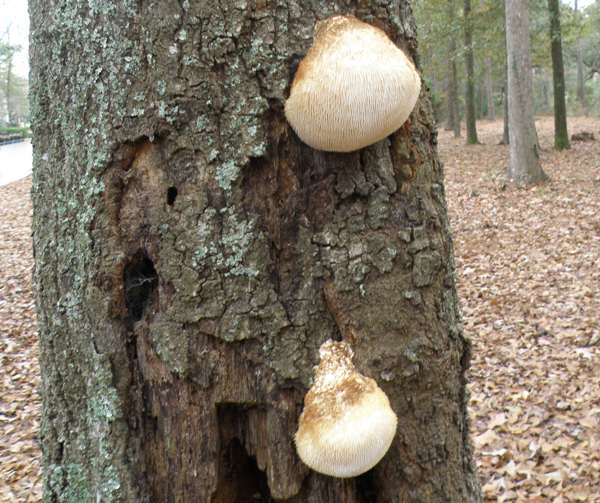
A very rare sight in Britain, where it is found mainly in southern England and eastern Wales, Hericium erinaceus occurs also in many parts of Europe, being particularly widespread and abundant in central and southern France. This species is also found in North America; I have seen woodlands in South Carolina adorned with Lion's Manes like lavish Christmas-tree decorations (and yes, it was during the last week of December!).
Taxonomic history
When French botanist-mycologist Jean Baptiste Francois (Pierre) Bulliard described Bearded Tooth fungus in 1780 he gave it the binomial scientific name Hydnum erinaceus. It was Christiaan Hendrik Persoon who in 1797 transferred this species to its present genus, whereupon its scientific name became Hericium erinaceus, which still stands today.
Synonyms of Hericium erinaceus include Hydnum erinaceus Bull., Hydnum caput-medusae Bull., Steccherinum quercinum Gray, and Hericium unguiculatum Pers.
Etymology
Hericium, the generic name, means pertaining to a hedgehog, and is a reference to the spiny fertile surfaces of fungi within this grouping. As so often with the type species of a genus, the specific epithet erinaceus means much the same as the generic name: like a hedgehog. Imagine an upturned, pallid hedgehog... It's a pretty accurate description, I'd say.
Identification guide
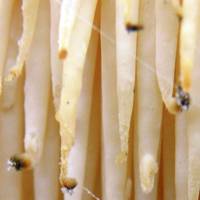 |
FruitbodyHericium erinaceus (also referred to as the Pom-Pom mushroom) often has a roundish fruitbody with spines all emerging from the same point and cascading down like a mop head. White or pale yellow-brown turning darker with age, the fruitbody is attached to the substrate by a very short, broad stipe. These are annual fruitbodies but they can recur in the same place on a tree for several years. The whole fruitbody can be as big as to 30cm across, although 15 to 20cm is more typical. Spines of Hericium erinaceus have pointed tips and range from 1 to 5cm long. |
SporesBroadly ellipsoidal to subglobose, smooth or with a very slightly roughened surface, 5-6 x 4-5.5µm; amyloid. Spore printWhite. |
|
Odour/taste |
Odour not distinctive; when cooked the taste is reportedly delicious and, to some at least, rather like lobster cooked in butter. |
Habitat |
Saprobic, nearly always on beech and oak trees, stumps and fallen logs in Britain, but sometimes on other hardwoods. Bearded Tooth fungus is also reported to fruit occasionally on piles of sawdust. |
Season |
July to November in Britain and Ireland. |
Similar species |
Hericium americanum is similar but the fruitbody usually has several branches. Hydnum rufescens and Hydnum repandum also have downward-projecting spines, but they are attached to a smooth-topped cap. Hericium coralloides is also very rare in the UK; it has a rubbery, coral-like branching fruitbody and is usually associated with beech and ash trees. Hericium cirrhatum is also very rare in the UK; it has shorter spines and a much thinner bracket-like fruitbody. |
Culinary Notes
When young and fresh Hericium erinaceus is a choice edible fungus with a fine flavour and texture similar to fish or tender meat. Fortunately there is no justification for raiding 'the wild' nowadays (and in Britain it is illegal to do so, as this rare species has legal protection under Schedule 8 of the Wildlife and Countryside Act 1981 which precludes picking and destruction of the fruitbodies), because it can now be grown in cultivation. Birch plugs impregnated with the white mycelium of this beautiful mushroom can be purchased for inserting into holes in cut logs. Once sealed with wax, the plugs allow the mycelium to spread throughout the log, and in due course cascades of white 'icicles' will emerge.
Reference Sources
Fascinated by Fungi, 2nd Edition, Pat O'Reilly 2016, reprinted by Coch-y-bonddu Books in 2022.
British Mycological Society (2010). English Names for Fungi
Dictionary of the Fungi; Paul M. Kirk, Paul F. Cannon, David W. Minter and J. A. Stalpers; CABI, 2008
Taxonomic history and synonym information on these pages is drawn from many sources but in particular from the British Mycological Society's GB Checklist of Fungi.
Acknowledgements
This page includes pictures kindly contributed by Simon Harding and Mike Smith.
Fascinated by Fungi. Back by popular demand, Pat O'Reilly's best-selling 450-page hardback book is available now. The latest second edition was republished with a sparkling new cover design in September 2022 by Coch-y-Bonddu Books. Full details and copies are available from the publisher's online bookshop...