Inocybe dunensis P. D. Orton - Dune Fibrecap
Phylum: Basidiomycota - Class: Agaricomycetes - Order: Agaricales - Family: Inocybaceae
Distribution - Taxonomic History - Etymology - Identification - Toxicity - Reference Sources
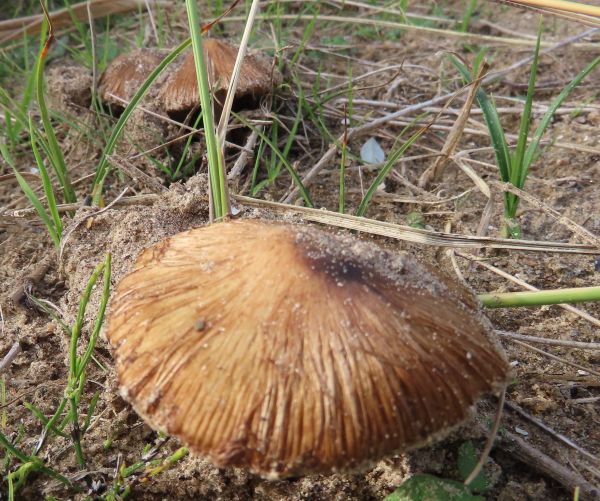
Inocybe dunensis commony referred to as the Dune Fibrecap, is mycorrhizal with Creeping Willow in sand-dune systems. It fruits in late summer and throughout autumn.
Inocybe is a difficult genus, with numerous species which, to the naked eye, appear to be virtually identical; the differentiating features can be examined with a microscope... but even then it is hard to separate some Inocybe species.
Alan Outen and Penny Cullington have produced a very detailed key, without which I would not want even to attempt identification of fibrecap mushrooms. It takes time: this is not a simple process, but it is very straightforward to follow. You need specimens in prime condition complete with any basal bulb, and it is crucial to minimise handling, otherwise this may remove caulocystidia (stem cystidia) or other identifying features. See the references section below.
Distribution
Inocybe dunensis is a common but localisd find in Britain and Ireland.
Most recorded finds of the Dune Fibrecap are from southern England, and the New Forest, in Hampshire, is one of the hotspots, but that may simply be due to intensity of recording effort rather than favoured distribution.
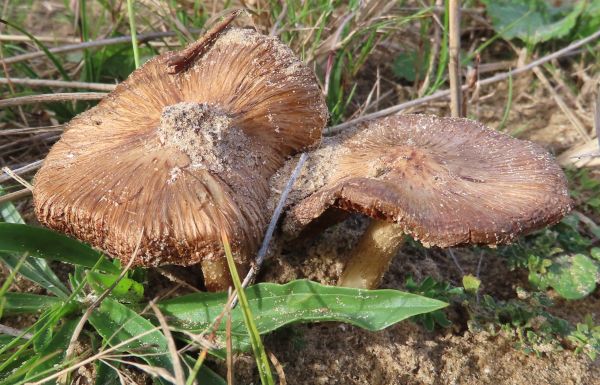
These toxic toadstools are also found in many parts of central and southern mainland Europe, where Inocybe dunensis is generally less of a rarity. Most of the Dune Fibrecaps shown on this page were found in the foothills of the Julian Alps in Slovenia in June 2014, but the lovely (to see but definitely not to eat!) specimen shown above was photographed in Bulgaria in 2009.
Taxonomic history
In a 1960 publication, British mycologist described this toxic toadstool, giving it the scientific binomial name Inocybe dunensis, by which name it is generally referred to today.
Synonyms of Inocybe dunensis include Inocybe heimiana Bon.
Etymology
Inocybe, the genus name, means 'fibrous head', while the specific epithet dunensis means 'of sand dunes'.
Toxicity
Inocybe dunensis is considered to be toxic - as are nearly all species in the Inocybe genus.
Identification guide
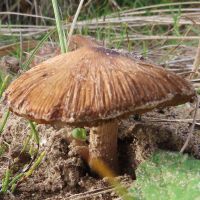 |
CapThe silky cap of Inocybe dunensis has a diameter of 1 to 3.5cm. Initially conical, it flattens as it matures, retaining a pointed umbo and streaky radial fibres that sometimes split at te margin with age. |
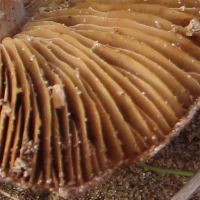 |
GillsCrowded and adnexed, the gills start off pale cream and gradually turn more brown and later rusty brown. Cheilocystidia(Cystidia on the edges of the gills): thick-walled, fusiform or sublangeniform; typically 43–74 × 9–18µm. |
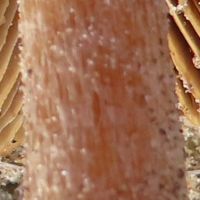 |
Stem2 – 5cm long and 0.4 - 1cm in diameter, the stem is solid; whitish to pale brown and appears frosted with longitudinal fibrils. The stem base is slightly swollen. |
 |
SporesOblong to Ellipsoidal or slightly bean-shaped, often with low smooth nodules, 9-17 x 5.2-10μm.
Spores of Inocybe dunensis, Dune Fibrecap Spore printDull brown. |
Odour/taste |
Spermatic odour. Do not taste, as these fungi are considered toxic. |
Habitat & Ecological role |
Mycorrhizal; occurring singly or in small groups in sand dunes with creepimg willow. |
Season |
Late June to November in Britain and Ireland. |
Similar species |
There are several macroscopically similar Inocybe species, including for example the Torn Fibrecap Inocybe rimosa, that can look very similar to Inocybe dunensis, so that the use of specialist keys, microscopic examination and sometimes chemical tests may be necessary to achieve confident identification to species level. |
Culinary Notes
This is considered a poisonous toadstool. Severa otherl Inocybe species are known to be poisonous and difficult to identify with confidenceand so they should all be avoided when gathering fungi for food.
Reference Sources
Fascinated by Fungi, 2nd Edition, Pat O'Reilly 2016, reprinted by Coch-y-bonddu Books in 2022.
BMS List of English Names for Fungi.
Alan Outen and Penny Cullington (2009), Keys to the British Species of Inocybe.
Kasturi Ravikant Bhambid, Donika A. D. (2014) Mushroom Poisoning: Etiology and Symptoms, Volgograd state medical University, Volgograd, Russia.
Dictionary of the Fungi; Paul M. Kirk, Paul F. Cannon, David W. Minter and J. A. Stalpers; CABI, 2008
Taxonomic history and synonym information on these pages is drawn from many sources but in particular from Index Fungorum.

Fascinated by Fungi. Back by popular demand, Pat O'Reilly's best-selling 450-page hardback book is available now. The latest second edition was republished with a sparkling new cover design in September 2022 by Coch-y-Bonddu Books. Full details and copies are available from the publisher's online bookshop...