Tricholoma ustaloides (Fr.) P. Kumm. - Charred Knight
Phylum: Basidiomycota - Class: Agaricomycetes - Order: Agaricales - Family: Tricholomataceae
Distribution - Taxonomic History - Etymology - Identification - Culinary Notes - Reference Sources
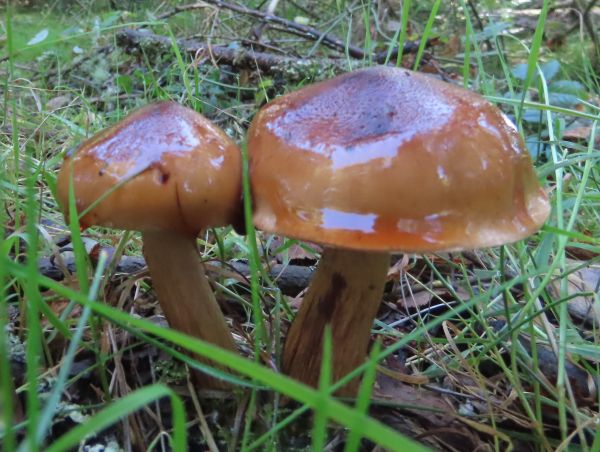
One of a group of closely-related brown-capped Tricholoma species, the Charred Knight is an uncommon to rare find in Britain. It is mycorrhizal with broadleaf trees, notably Beeches and Oaks, where it usually occurs in small groups.
Distribution
The Charred Knight mushroom is an inrequent find throughout Britain and in Ireland. Tricholoma ustaloides is also found throughout much of mainland Europe.
Taxonomic history
This mushroom was described scientifically in 1954 by the French mycologist Henri Romagnesi, who gave it its currently-accepted scientific name Tricholoma ustaloides.
Etymology
Tricholoma was established as a genus by the great Swedish mycologist Elias Magnus Fries. The generic name comes from Greek words meaning 'hairy fringe', and it must be one of the least appropriate mycological genus names, because very few species within this genus have hairy or even shaggily scaly cap margins that would justify the descriptive term. The specific epithet ustaloides comes from the Latin adjective ustalis and means burnt or charred, with the addition of '-oides' meaning 'resembling'. Hence, Tricholoma ustaloides resembles the Cgarred Knight Tricholoma ustale.
Identification guide
 |
CapChestnut brown to reddish brown, bell shaped initially. becomming irregularly convex and flattening but often retaining a broad umbo; surface smooth and very slimy in wet weather; 4 to 8cm across when fully expanded. |
 |
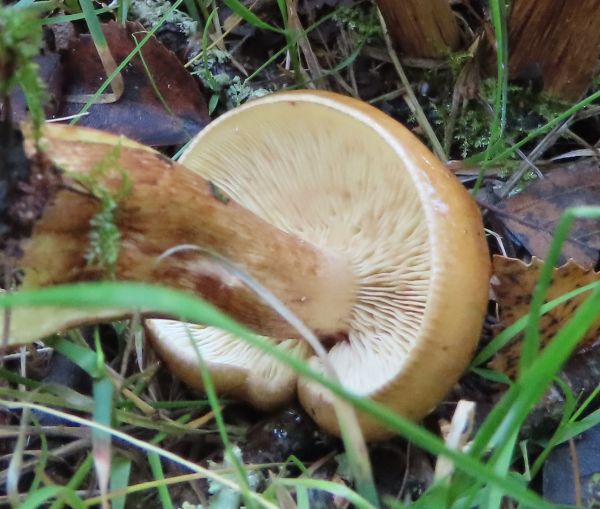
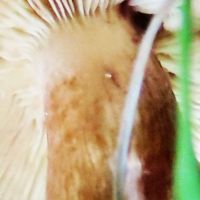
GillsWhite or pale ochre at first, developing irregular rusty brown spots with age oir when bruised; crowded; sinuate or emarginate. |
 |
StemWhite and fibrous, lined longitudinally with red-brown fibrils, usually darker towards the base; cylindrical or slightly clavate; 3 to 6cm long, 1 to 1.5cm diameter; no ring. The stem flesh is white, turning reddish brown when cut or bruised. There is a clearly distinguishable pale cream or whitish zone at the top of the stem; a feature separating this species from the Burnt Knight Tricholoma ustale. |
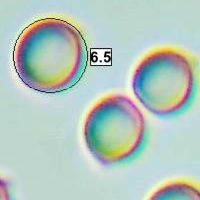 |
SporesEllipsoidal, smooth, 5.5-7 x 3.5-5µm (narrower than the spores of Tricholoma ustale.)
Spores of Tricholoma ustaloides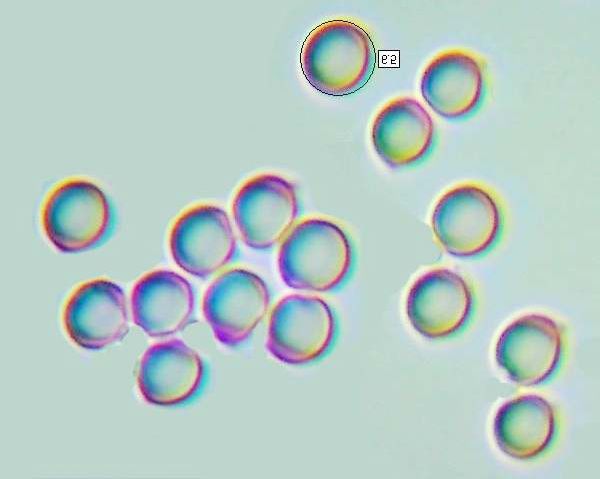 Spore printWhite |
Odour/taste |
Strong mealy (farinaceous) smell; immediately bitter taste. |
Habitat & Ecological role |
Ectomycorrhizal with broadleaf trees, particularly Oak and Beech species. |
Season |
Late summer and autumn in Britain and Ireland. |
Similar species |
Tricholoma fulvum occurs in wet grassland under birches. Tricholoma ustale is more common (in Britain) and does has a distinct white region at the stem apex; it has a weakly farinaceous odour and a less viscid cap. |
Culinary Notes
Tricholoma ustaloides is not recommended as an edible mushroom, and its rarity preludes gathering except for scientific study.
Reference Sources
Fascinated by Fungi, 2nd Edition, Pat O'Reilly 2016, reprinted by Coch-y-bonddu Books in 2022.
Kibby, G (2013) The Genus Tricholoma in Britain, published by Geoffrey Kibby
BMS List of English Names for Fungi.
Dictionary of the Fungi; Paul M. Kirk, Paul F. Cannon, David W. Minter and J. A. Stalpers; CABI, 2008
Taxonomic history and synonym information on these pages is drawn from many sources but in particular from Index Fungorum.

Fascinated by Fungi. Back by popular demand, Pat O'Reilly's best-selling 450-page hardback book is available now. The latest second edition was republished with a sparkling new cover design in September 2022 by Coch-y-Bonddu Books. Full details and copies are available from the publisher's online bookshop...