Anchusa calcarea - Calcareous Bugloss
Phylum: Magnoliophyta - Class: Equisetopsida - Order: insertae sedis - Family: Boraginaceae
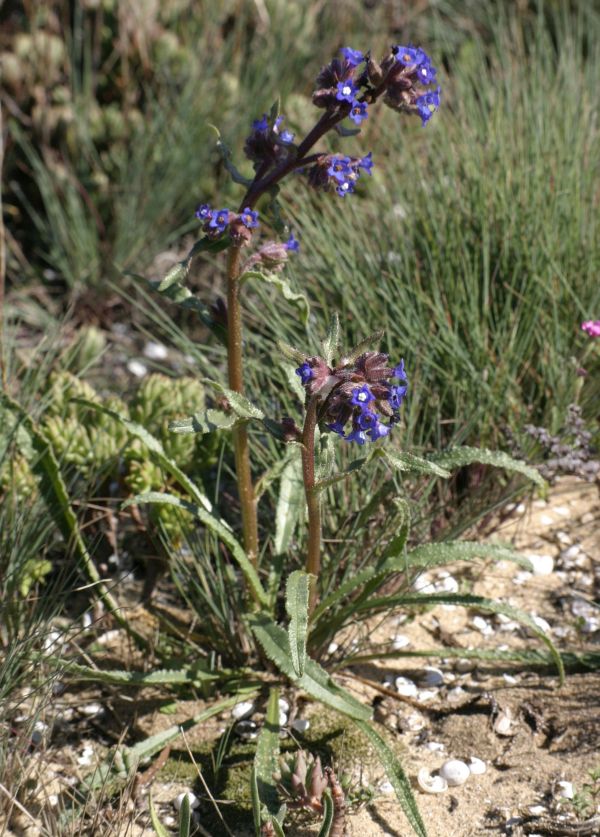
Anchusa calcarea, Calcareous Bugloss, is sometimes referred to as Chalky Anchusa or Chalky Alkanet.
Description
This bristly perennial typically grows to a height of 0.4 to 0.7m and has an upright nature. The lower leaves are narrowly lanceolate, stiff and hairy. Smaller leaves up the stems are more erect.
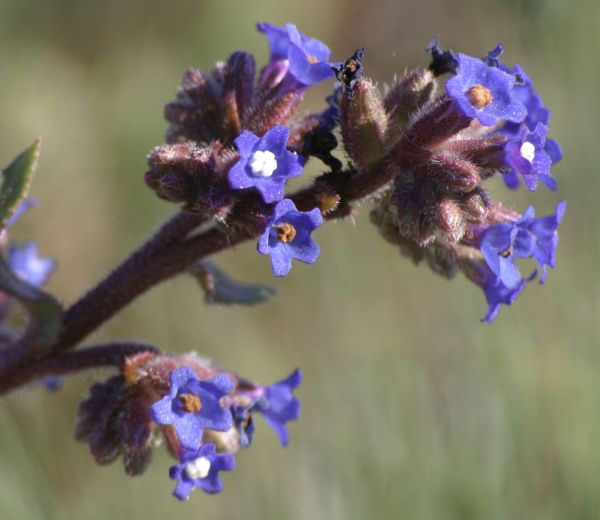
Flowers, typically 8mm across, grow in cymes (clusters) and are tubular with five deep blue-purple petals. ( When the flower buds first appear they are tinged with pink.)
Distribution
This striking wildflower can be found throughout the western Mediterranean region and in parts of North Africa. Elsewhere, including southern Britain, Calcareous Bugloss is an introduced alien species occasionally appearing in the wild as a garden escape.
Habitat
Calcareous Bugloss favours dry sunny locations and is seen most often on roadside verges, in abandoned fields and on disturbed wasteland.
Blooming times
In Portugal and Spain, Anchusa calcarea can be seen in flower from March until June.
Etymology
The specific epithet calcarea refers to this plant's habitat preference, 'favouring chalk'.
Similar species
Large Blue Alkanet Anchusa azurea has larger pale blue flowers.
Borage Borago officinalis, which is cultivated in herb gardens in Britain and Ireland and used as an attractive addition to the fruit cup Pimms, is a close relative of this lovely wildflower.
The taxonomic position of wildflowers in the family Boraginaceae, which includes the alkanets, forget-me-knots and of course Borage itself, is still not determined. Some people place these flowers in the order Lamiales, while others have designated them as Boraginales. We, like many, simply mark the whole family as Insertae sedis - position yet to be decided.
The specimens shown here were seen in the Algarve region of southern Portugal during May.


Please Help Us: If you have found this information interesting and useful, please consider helping to keep First Nature online by making a small donation towards the web hosting and internet costs.
Any donations over and above the essential running costs will help support the conservation work of Plantlife, the Rivers Trust and charitable botanic gardens - as do author royalties and publisher proceeds from books by Pat and Sue.