Paraisaria gracilis (Grev.) Luangsa-ard, Mongkols. & Samson
Phylum: Ascomycota - Class: Sordariomycetes - Order: Hypocreales - Family: Ophiocordycipitaceae
Distribution - Taxonomic History - Etymology - Identification - Culinary Notes - Reference Sources
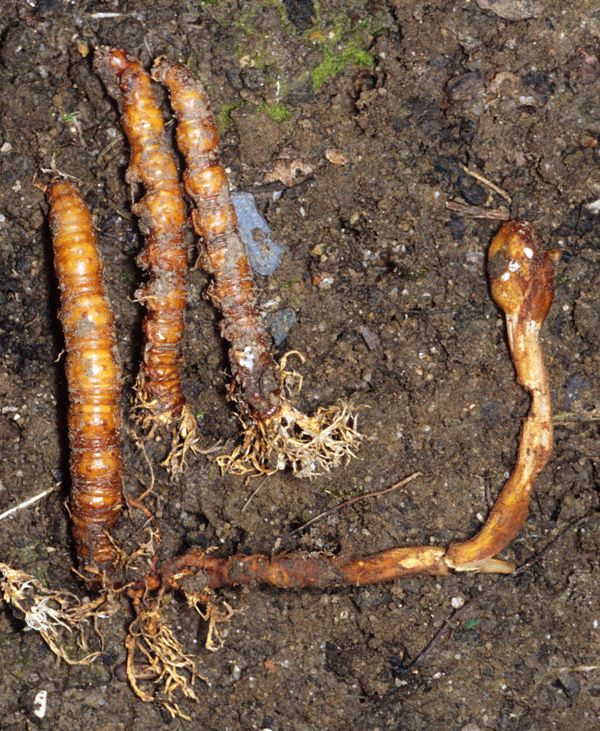
This club fungus is parasitic on insects - mainly larvae of various moths, beetles and ants. In this picture, the hosts are larvae of the Swift Moth Hepialus lupulinus.
Description
Parasitising buried larvae (particularly of the Swift Moth) during the spring and summer months, this fungs produces a pale-stemmed club structure with a pear-shaped yellowish-orange head.
Distribution
Rarely recorded in Britain, where it is found mainly in Scotland, this ascomycete species has a world-wide distribution.
Taxonomic history
English mycologist Dr Robert Kaye Greville (1794-1866) first described this club fungus in 1823, giving it the scientific name Xylaria gracilis. In 2019, Luangsa-ard, Mongkols. & Samson renamed it Paraisaria gracilis, which is now its generally-accepted scientific name.
Synonyms of Paraisaria gracilis include Xylaria gracilis Grev., Cordyceps gracillis (Grev.) Durieu & Mont., and Ophiocordyceps gracilis (Grev.) G.H. Sung, J.M. Sung, Hywel-Jones & Spatafora.
Etymology
The specific epithet gracilis comes from Latin and means slender.
Identification guide
 |
Fruitbody0.5 to 4cm long and 2 to 4mm dia., the fertile head is yellowish orange and pear shaped. The base of the stem is attached to a dead insect pupa below the soil surface. The infertile stem is typically 2.5 to 4cm long and 2 to 5mm diameter. |
Perithecia and asciClose inspection of the surface of the cap of this club fungus reveals tiny raised pores at the tops of spherical perithecia The flask-like perithecia are lined with asci 260 - 600µm long x 3.5-5µm diameter. Within each ascus eight ascospores develop. |
|
SporesAscospores are multiseptate (segmented) and filiform (in the form of long threads) eventually breaking into ellipsoidal part-spore segments (rather like a string of sausages), individual part-spore segments measuring 5-9 x 1.5-2µm. Spore printWhite. |
|
Habitat & Ecological role |
In scrubby grassland or on mossy woodland edges, always attached to an insect larva below the ground, often a Swift Moth. |
Season |
Late spring, summer and autumn. |
Culinary Notes
Paraisaria gracilis is not generally considered to have any major culinary value.
Reference Sources
Læssøe, T. & Petersen, J.H. (2019) Fungi of Temperate Europe, Volume 2.
Fascinated by Fungi, 2nd Edition, Pat O'Reilly 2016, reprinted by Coch-y-bonddu Books in 2022.
Dictionary of the Fungi; Paul M. Kirk, Paul F. Cannon, David W. Minter and J. A. Stalpers; CABI, 2008
Taxonomic history and synonym information on these pages is drawn from many sources but in particular from Index Fungorum.
Acknowledgements
This page includes pictures kindly contributed by Betty and Tony Rackham.

Fascinated by Fungi. Back by popular demand, Pat O'Reilly's best-selling 450-page hardback book is available now. The latest second edition was republished with a sparkling new cover design in September 2022 by Coch-y-Bonddu Books. Full details and copies are available from the publisher's online bookshop...