Cassida murraea - Fleabane Tortoise Beetle
Phylum: Arthropoda - Class: Insecta - Order: Coleoptera - Family: Chrysomelidae
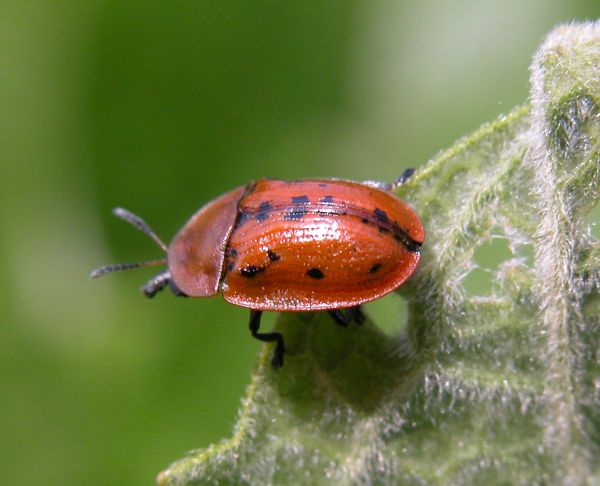
This fascinating beetle feeds almost exclusively on Common Fleabane Pulicaria dysenterica. One of the best ways to find either the adults or their developing larvae is to look on the undersides of those Fleabane leaves that have holes in them. An example of such a hole is visible on the lower picture on this page.
Description
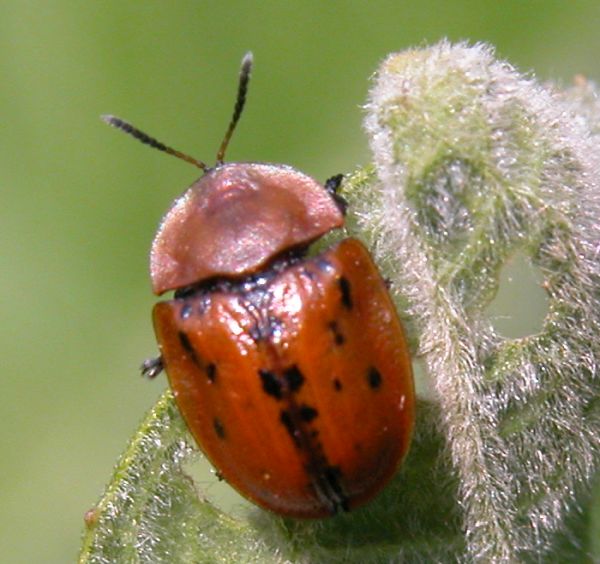
Distinctive and colourful insects 6.5 to 9mm long and with a tortoise-like shape of much lower profile that some superficially similar ladybirds, the adults are black underneath but initially green turning gradually orange-red above. The elytra (wing cases) usually develop small black spots, the numbers and shapes of which are very variable; however, while having the same background colour as the elytra, the pronotrum is unspotted. The legs and antennae are blackish.
Distribution
Mainly coastal, in Britain the Fleabane Tortoise Beetle is largely concentrated in South Wales and Southwest England. Elsewhere this species occurs in much of mainland Europe and western Asia, and it is recorded as an alien introduction in parts of North America.
Habitat
This largely host-specific beetle is found nearly always on the leaves of Common Fleabane, which is a plant of damp grassland and wasteland areas, very often within a few miles of the coast. Occasionally, however, these pretty little beetles are also recorded on Marsh Thistle Cirsium palustre.
Lifecycle
Adults can usually be seen between April and September, with May generally the peak emergence month in southern Britain. The curiously curved legleess larvae of these beetles are green and have a forked tail on which they carry a 'shield,' made from their own faecal excretions mixed with their shed skins and sometimes plant debris. The shield serves as a camouflage disguise - a form of protective mechanism against predation.
Overwintering as adults, the beetles emerge in spring and summer, the females laying their creamy-white eggs in rows or clusters on the undersides of Fleabane leaves. The tiny eggs take between four and eight days to hatch, and the emerging larvae also feed on Fleabane before pupating in summer and early autumn.
Acknowledgements
This page includes pictures kindly contributed by Betty and Tony Rackham.
References
NBNatlas - UK distribution map
Harde K.W. & Severa F. (1984) Field Guide in Colour to Beetles. Littlehampton Book Services.