Harmonia axyridis, Harlequin Ladybird
Phylum: Arthropoda - Class: Insecta - Order: Coleoptera - Family: Coccinellidae
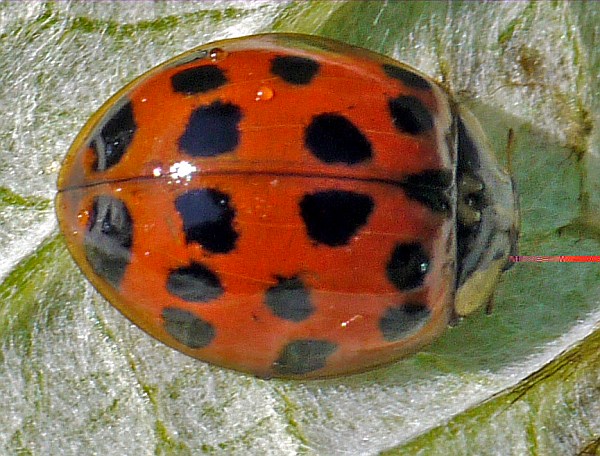
The Harlequin Ladybird was first recorded in Britain in 2004, since when it has spread and become very common in England and Wales and is seen increasingly in parts of Ireland and Scotland.
Description
At 8 to 10mm in length, these are big ladybirds. Identification is not always easy, because their colouring is very variable; however, two distinctive colour forms are the most common. One for has orange elytra (wing cases) with up to 18 roundish black spots; the other, melanic form, has black elytra with two or more red spots.

Habitat
Harlequin Ladybirds are now very commonly seen not only in the countryside but also in houses and gardens across much of Britain and Ireland.

Distribution
The Harlequin Ladybird is native to Asia but has spread across mainland Europe and into Britain. This species was also introduced into North America to control aphids towards the end of the 20th century, but it has outcompeted other ladybirds there and is now the most common ladybird in most parts of that continent.
Lifecycle
Like other ladybirds, the Harlequin has four stages in its lifecycle: egg, larva, pupa and winged adult. Females produce several broods of eggs during spring, summer and early autumn. The eggs are laid on the leaves of plants, notably species favoured by aphids. The larvae, which are black and orange (see below) feed on aphids and other small insects, and in about four weeks they grow to 10mm in length before pupating. Adults hibernate - often in buildings, where they tend to favour the warmer south-facing side.

The larvae and adults are agressive feeders, eating not only aphids but also the eggs and young larvae of other ladybird species. Adult Harlequin Ladybirds can usually be seen in Britain from March through to November.
Acknowledgements
This page includes pictures kindly contributed by Betty and Tony Rackham.
References
O'Reilly, Pat. (1997; 8th reprint 2010) Matching the Hatch. Shrewsbury: Quiller Publishing.
Harde K.W. & Severa F. (1984) Field Guide in Colour to Beetles. Littlehampton Book Services.
Excited by rivers and streams? So are we, and we're pretty sure you would find the Winding River Mystery trilogy of action-packed thrillers gripping reading too. Dead Drift, Dead Cert, and Dead End are Pat O'Reilly's latest river-based novels, and now they are available in ebook format. Full details on our website here...
Buy each volume in ebook format for only £2.47 on Amazon... Paperbacks also available on Amazon at £6.95 each. All proceeds go towards keeping the First Nature website online.
Please Help Us: If you have found this information interesting and useful, please consider helping to keep First Nature online by making a small donation towards the web hosting and internet costs.
Any donations over and above the essential running costs will help support the conservation work of Plantlife, the Rivers Trust and charitable botanic gardens - as do author royalties and publisher proceeds from books by Pat and Sue.