Hummingbird Hawk-moth - Macroglossum stellatarum
Phylum: Arthropoda - Class: Insecta - Order: Lepidoptera - Family: Sphingidae
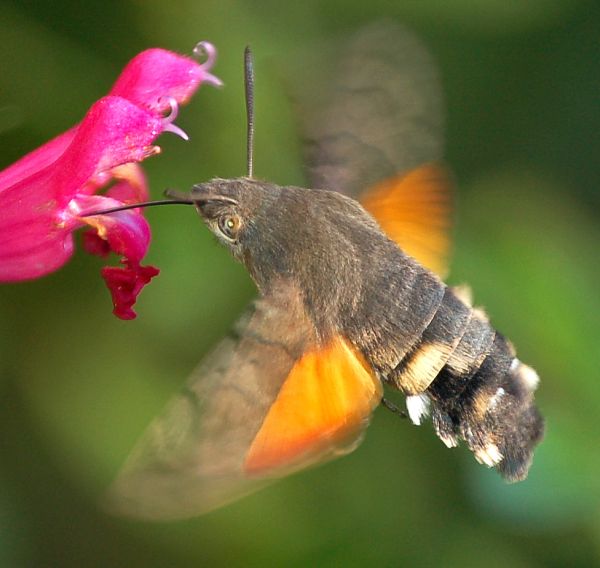
The hummingbird Hawk-moth is a migrant visitor to the UK. It originates in Southern Europe and can be seen on the wing in Britain and Ireland between April and December.
Description
Male and female Hummingbird Hawk-moths look almost identical. If you see both sexes close up you may notice that the female has a stouter body and slightly shorter and slimmer antennae than the male.
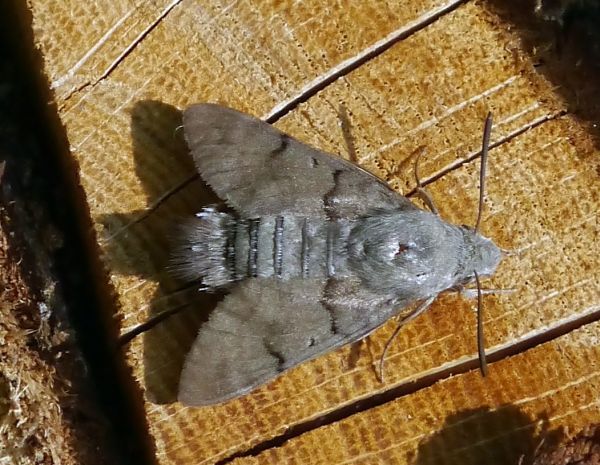
The wingspan ranges between 5.0 and 5.8cm. Forewings are dull greyish-brown marked with dark lines, while the hindwings are bright orange with dark borders. The thorax and abdomen are a greyish brown, with a black-and-white checkered fan-like tip.
Distribution
In Britain the distribution of the Hummingbird Hawk-moth varies from year to year depending on the strength and duration of southerly winds. Although recorded in England, Wales, Scotland and Ireland, most years these fascinating day-flying moths are most common and plentiful in Southern and Eastern England and in South Wales, most particularly in coastal areas.
This Eurasian moth species is also recorded in temperate parts of Europe, Asia, and North Africa.
Habitat
These moths favour open sunny places with plenty of nectar-producing flowers. In the UK and Ireland they are most often seen in gardens and parks and on coastal herb-rich dunes and clifftops. Their main larval foodplants are bedstraws, and particularly Lady's Bedstraw and Heath Bedstraw.
Lifecycle
The Hummingbird Hawk-moth usually produces two or more broods a year. Females lay about 200 glossy, pale-green eggs singly on their hostplants, mainly Galium species (bedstraws). In typically one to two weeks the eggs hatch and tiny translucent-yellow caterpillars emerge. As they mature, the larvae turn green and develop white or yellow stripes and a blue-tipped horn on their rear end. They feed on the leaves of their hostplant for two to three weeks. Fully grown caterpillars reach up to 60mm in length before moving down to the base of the plant. Low down on the plant or among leaf litter, the caterpillars spin a coccoon in which they pupate.
Adults Hummingbird Hawk-moths emerge from their pupal coccoons after two to three weeks. Unlike other hawk-moths, they overwinter as winged adults.
Acknowledgements
This page includes pictures kindly contributed by Betty and Tony Rackham.
Studying butterflies and moths...

Excited by rivers and streams? So are we, and we're pretty sure you would find the Winding River Mystery trilogy of action-packed thrillers gripping reading too. Dead Drift, Dead Cert, and Dead End are Pat O'Reilly's latest river-based novels, and now they are available in ebook format. Full details on our website here...
Buy each volume in ebook format for only £2.47 on Amazon... Paperbacks also available on Amazon at £6.95 each. All proceeds go towards keeping the First Nature website online.
Please Help Us: If you have found this information interesting and useful, please consider helping to keep First Nature online by making a small donation towards the web hosting and internet costs.
Any donations over and above the essential running costs will help support the conservation work of Plantlife, the Rivers Trust and charitable botanic gardens - as do author royalties and publisher proceeds from books by Pat and Sue.