Betonica alopecuros - Yellow Betony or Foxtail Betony
Phylum: Magnoliophyta - Class: Equisetopsida - Order: Lamiales - Family: Lamiaceae
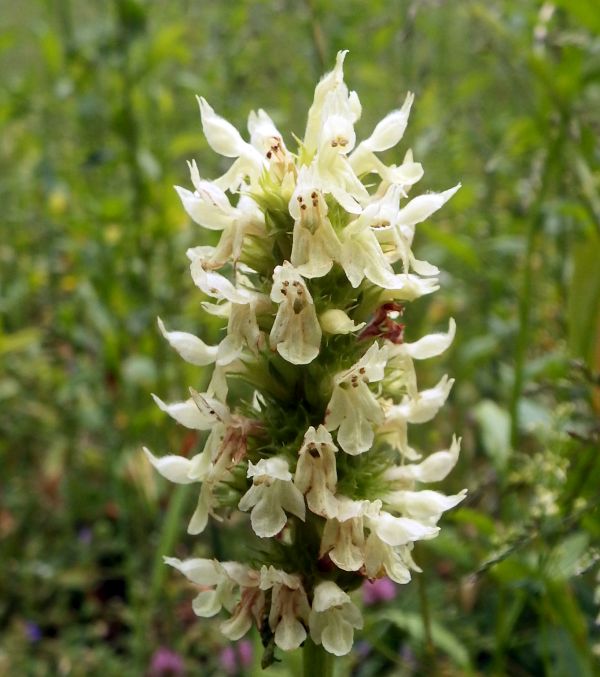
Rather similar in flower form to Purple Betony (which is also known as Wood Betony or Common Hedgenettle Betonica officinalis) this wildflower is sometimes recorded by its synonymous scientific name Stachys alopecuros.
Description
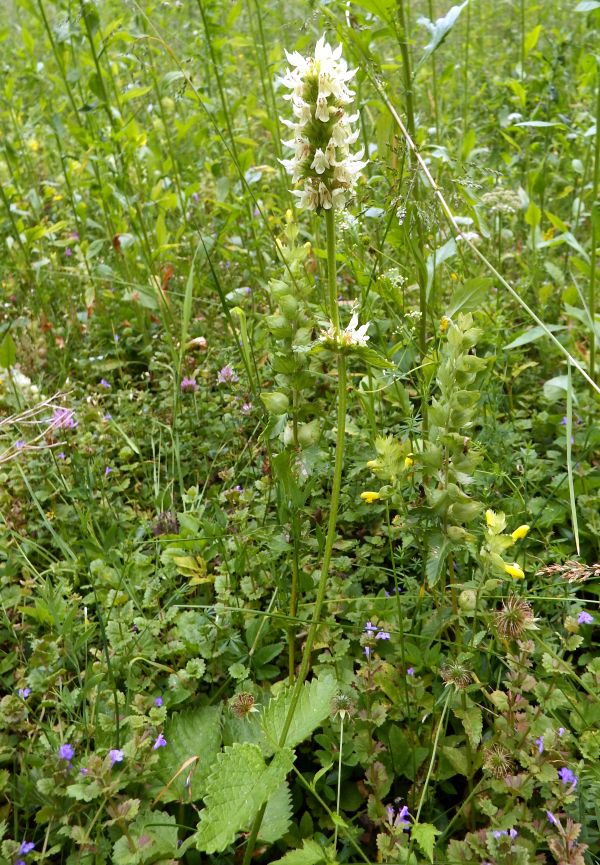
This perennial member of the mint family Lamiaceae grows to a height of typically 20 to 40cm. Yellow Betony spreads both by seeds and vegetatively via creeping rhizomes. It has erect stems topped by dense cylindrical flower heads typically 3cm across and 10 to 15cm long which are said to resemble a fox's tail. The cream or pale yellow two-lipped flowers are typically 15 to 20mm long and comprise a hooded upper lip and a tri-lobed lower lip.
The basal leaves are stalked, wrinkly and triangular to heart shaped, typically 5 to 6cm long and 4 to 5cm across. There are usually one or two pairs of smaller unstalked leaves up the stem, often with flowers in the axils.
Distribution
This striking wildflower iis native to central and southern Europe. (It is not recorded as a wildflower in Britain and Ireland.) The specimens shown on this page were photographed in Slovenia.
Habitat
Yellow Betony is an alpine and subalpine wildflower that grows on alkaline soils. It is most often see on herb-rich rocky slopes and in upland meadows.
Blooming Times
Flowers of Betonica alopecuros can usually be seen between early June and the end of August.
Etymology
Betonica, the genus name, comes from Medieval Latin noun betōnia and is thought to refer to the Vettones, who used to live in Lusitania (now Portugal and western Spain). The specific epithet alopecuros is derived from Ancient Greek words meaning a fox's tail - a reference to the foxtail-like cylindrical flower head.
Similar Species
Betony, sometimes called Purple Betony or Wood Betony, has purplish flowers.
Hedge Woundwort Stachys sylvatica and Marsh Woundwort Stachys palustris are similar in stature and form but have purplish flowers in whorls that are much more widely spaced.

Sue Parker's latest ebook is a revised and enlarged edition of Wild Orchids in The Burren. Full details here...
Buy it for just £5.95 on Amazon...

Please Help Us: If you have found this information interesting and useful, please consider helping to keep First Nature online by making a small donation towards the web hosting and internet costs.
Any donations over and above the essential running costs will help support the conservation work of Plantlife, the Rivers Trust and charitable botanic gardens - as do author royalties and publisher proceeds from books by Pat and Sue.