Centaurea montana - Perennial Cornflower
Phylum: Magnoliophyta - Class: Equisetopsida - Order: Asterales - Family: Asteraceae
Description
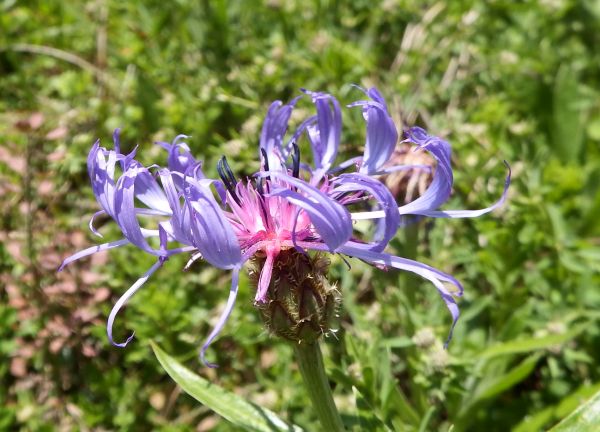
This perennial wildflower, a close relative of the knapweeds, grows to between 40 and 60cm in height with tough, greyish-green loosely branching stems and lanceolate (or occasionally slightly lobed) leaves up to 16cm long. The leaves are grey-green on the upper sides but more silvery and finely hairy beneath.
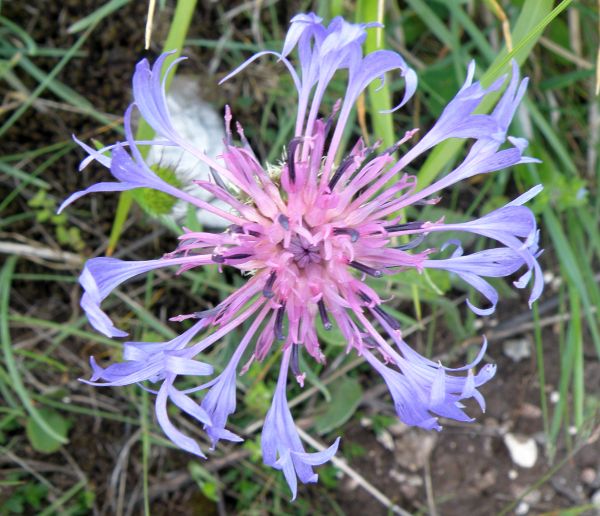
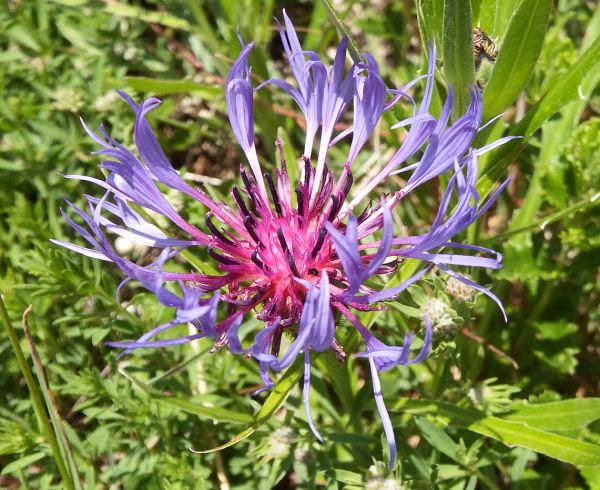
What makes the Perennial Cornflower so striking are its flowers. Like other members of the Daisy family, each flower head comprises a cluster of florets. The overall diameter of a flower head is typically between 4 and 6 cm. The outer florets are violet-blue, lilac, or occasionally deep blue, and there are contrasting reddish-purple florets at the centers.
Distribution
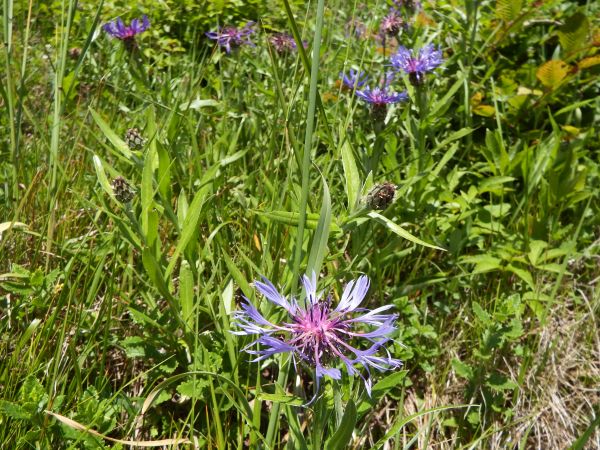
Native to mountainous countries in central and southern Europe, Centaurea montana has long been a popular flower for gardens in many other temperate parts of the world, so that escapees can often be seen in the wild in many countries inclusing Britain and Ireland and North America.
Perennial Cornflower is now found in many parts of North America, where it is a naturalised introduced species and, as in Europe, a very popular choice for growing from seed in parks and gardens.
Habitat
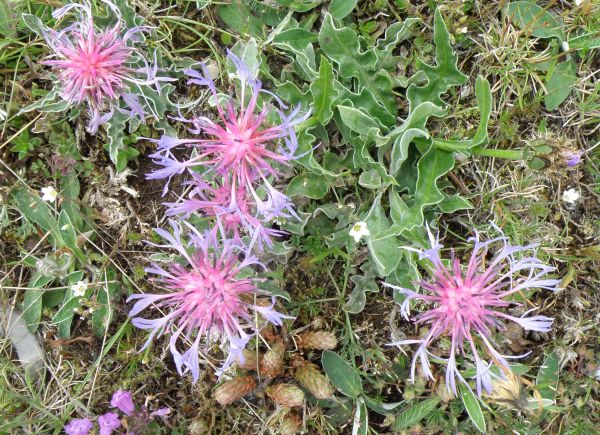
Perennial Cornflowers grow wild in mountain meadows, mountain roadside slopes and high-altitude woodland edges; they favour fast-draining soils and sunny or partially shaded locations.
Flowering times
In their native habitat, Perennial Cornflowers bloom from May through into August.
Similar Species
A close relative, Centaurea cyanus is an annual that was once a common sight in cornfields hence its common name Cornflower.
Etymology
Centaurea, the genus name, comes from the Centaur Chiron, who used the flowers of this plant genus as a poultice to cover a festering wound made by an arrow dipped in Hydra's blood. The wound was cured and therefore, the story goes, cornflowers were given the name Centaurea. The specific epithet montana refers to the typical montane (mountain grassland) habitat of these flowers in the wild, of course.

Sue Parker's latest ebook is a revised and enlarged edition of Wild Orchids in The Burren. Full details here...
Buy it for just £5.95 on Amazon...

Please Help Us: If you have found this information interesting and useful, please consider helping to keep First Nature online by making a small donation towards the web hosting and internet costs.
Any donations over and above the essential running costs will help support the conservation work of Plantlife, the Rivers Trust and charitable botanic gardens - as do author royalties and publisher proceeds from books by Pat and Sue.