Cochlearia danica - Danish Scurvy-grass
Phylum: Magnoliophyta - Class: Equisetopsida - Order: Brassicales - Family: Brassicaceae
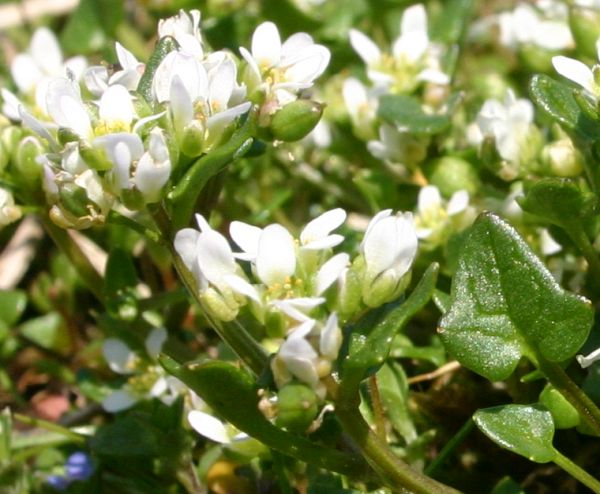
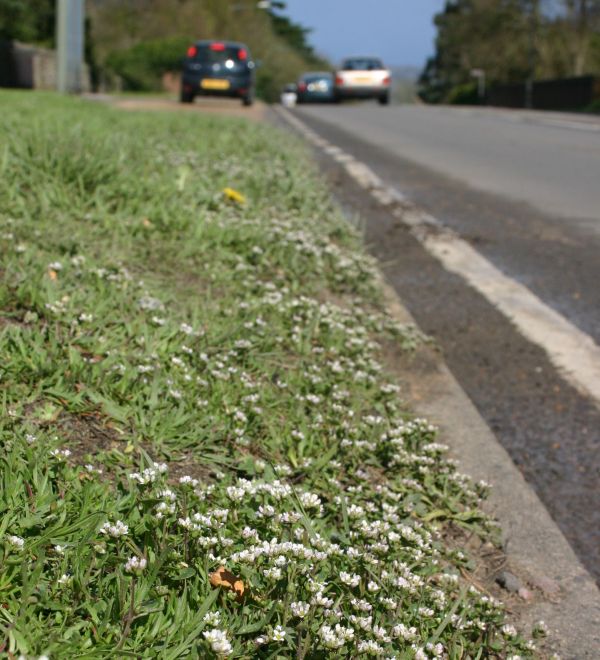
Originally a plant of sea walls, sand dunes and other coastal habitats, Danish Scurvy-grass (sometimes written Danish Scurvy Grass or Danish Scurvygrass) has now been more widely distributed, mostly by vehicle tyres. In Britain and Ireland his salt-tolerant member of the cabbage family can be seen on the verges of main roads and edging motorway hard shoulders and central reservations inland.
Description
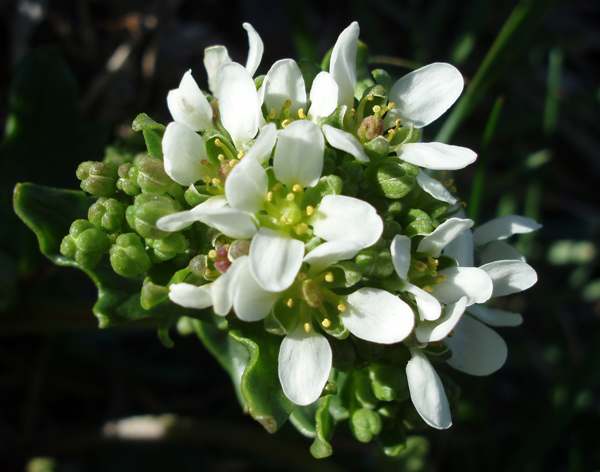
Much smaller than Common Scurvey-grass, plants of Danish Scurvy-grass are rarely more than 15cm tall and often a mere 5cm in height. White or pale lilac, the flowers, each with four petals, are 4 to 5mm across. This annual or biennial plant sometimes overwinters. Its succulent lower leaves are slightly tri-lobed and stalked; they are usually dark green, occasionally with a pink or purplish tinge, and they tend to hug the ground.
Once the short-lived petals have fallen from the flowers, roundish seed pods swell and ripen.
Distribution
Found throughout Britain and Ireland, Danish Scurvy-grass occurs also in western Europe including the Iberian Peninsula. It is an introduced plant in many eastern European countries and in the Balkans and north-west Russia.
Habitat
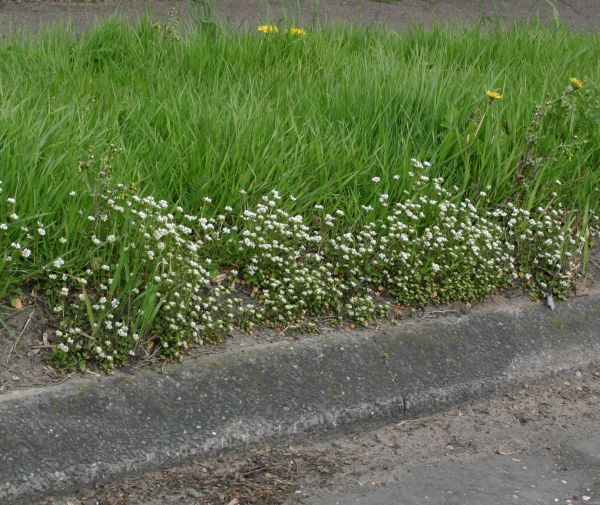
This plant is now most common on the verges of roads. Near to the sea it grows also on shingle shores, walls, old buildings and rocky cliffs as well as beside gravel paths on clifftops and along estuaries and the edges of salt marshes.
Blooming Times
The first flowers appear in January, but March is usually the best month for this member of the Cabbage family. Near to the coast, you will see odd patches of Danish Scurvy-grass in bloom throughout the summer.
Uses
Sailors ate scurvy-grass when at sea to ward off the debilitating diseaseof scurvy, which is caused by a deficiency of vitamin C.
The symptoms of scurvy are spongy and bleeding gums, bleeding beneath the skin, and extreme weakness. The sharp-tasting leaves of various scurvy-grass species are very high in vitamin C, and at one time scurvy-grass ale was a popular tonic drink.
Etymology
Cochlearia, the generic name, comes from the Greek noun kochlarion, meaning a spoon; it is a reference to the spoon-shaped lower leaves of plants in this genus.
The specific epithet danica is Latin and refers to Denmark - just one of many countries on mainland Europe where this species is common.
The common name is sometimes written as Scurvygrass or occasionally as Scurvy Grass.
Similar Species
Several similar Scurvy-grass species occur in Britain and Ireland, but the two most common species are Cochlearia officinalis and Cochlearia danica.
The Danish Scurvy-grass plants shown on this page were photographed in Wales during March and April.

Sue Parker's latest ebook is a revised and enlarged edition of Wild Orchids in The Burren. Full details here...
Buy it for just £5.95 on Amazon...

Please Help Us: If you have found this information interesting and useful, please consider helping to keep First Nature online by making a small donation towards the web hosting and internet costs.
Any donations over and above the essential running costs will help support the conservation work of Plantlife, the Rivers Trust and charitable botanic gardens - as do author royalties and publisher proceeds from books by Pat and Sue.