Iberis sempervirens - Evergreen Candytuft
Phylum: Magnoliophyta - Class: Equisetopsida - Order: Brassicales - Family: Brassicaceae
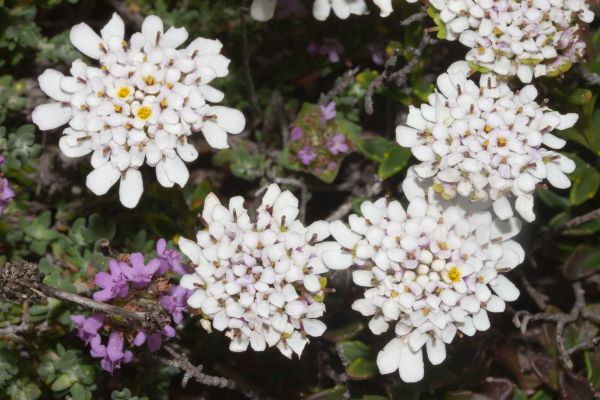
Evergreen Candytuft is a cushion-forming perennial with sweetly-scented flowers in springtime.
Description
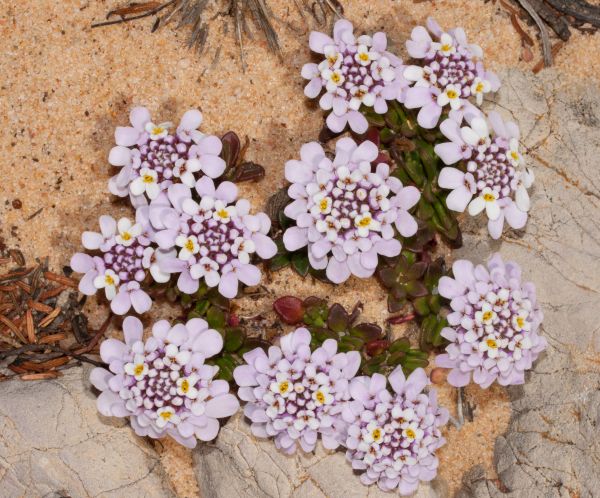
Evergreen Candytuft produces cushions comprising many flat-topped flower clusters (umbels) 3 nto 4cm across, each comprising typically 15 to 25 individual flowers. Plants can grow up to 30cm tall but are more typically 10 to 25cm in helght. The individual flowers, typically 5 to 102mm across, each having four mauve or at least mauve-tinted (only very occasionally in our experience are they pure white) petals, the outer pair up to twice as long as the inner pair - most noticeably so in those at the outer edge of a cluster. (In cutivation, many more strident colour forms have been developed, and these sometimes appear confusingly as garden escapes well away from habitation.)
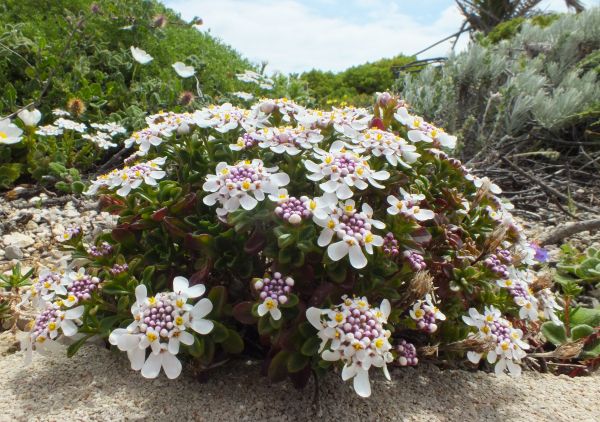
The leathery leaves of Evergreen Candytuft are typically 3 to 7cm long, darkish green sometimes tinged with purple; they are spathulate to lanceolate and narrowest towards the base of the leaf.

Distribution
Native and common in Iberia (Spain and Portugal) the Mediterranean region and some parts of southern central Europe, this plant is also found in parts of North Africa. Elsewhere, including Britain, Ireland and North America, this is an introduced garden plant which in some regions (notably southern England) has escaped and spread into the wild.
Flowering times
In their native Mediterranean range, the flowers of Evergreen Candytuft are at their best between March and June.
Habitat
Dry sandy or gravelly coastal areas are the natural habitat of Evergreen Candytuft in its native Mediterranean region. This species favours alkaline or neutral soil in sunny locations.
Etymology
The genus name Iberis may come from the Greek word for cress, or it may be a reference to the Iberian Peninsula (Spain and Portugal) where this plant is most common, The specific epithet sempervirens comes from Latin and means 'evergreen'.
Similar Species
In the Algarve, in particular, we often see Burnt Candytuft Aethionema saxatile which is superficially similar to Evergreen Candytuft

Sue Parker's latest ebook is a revised and enlarged edition of Wild Orchids in The Burren. Full details here...
Buy it for just £5.95 on Amazon...

Please Help Us: If you have found this information interesting and useful, please consider helping to keep First Nature online by making a small donation towards the web hosting and internet costs.
Any donations over and above the essential running costs will help support the conservation work of Plantlife, the Rivers Trust and charitable botanic gardens - as do author royalties and publisher proceeds from books by Pat and Sue.