Medicago orbicularis - Blackdisc Medick
Phylum: Magnoliophyta - Class: Equisetopsida - Order: Fabales - Family: Fabaceae
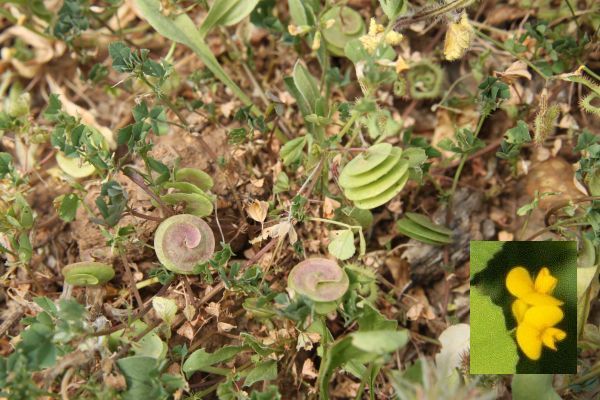
Blackdisc Medick, also known as Large-disc Medick or Button Medick, is a low-growing spreading annual of disturbed wasteland and roadside verges, olive groves and fallow fields. It is sometimes used as a fodder crop.
Description
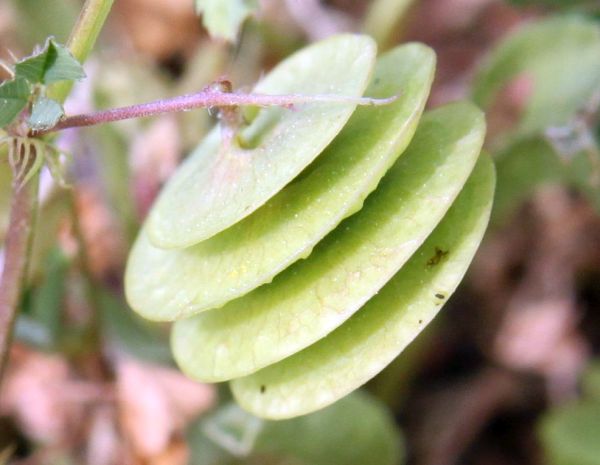
In many ways, while in flower this plant resembles many other members of the pea family, Fabaceae - for example Black Medick Medicago lupulina. The flowers, typically a mere 4 or 5 mm long, are yellow, characteristically pea-like, and generally borne in pairs on short stalks. Once the seeds develop, however, the distinctiveness of this plant becomes very clear: Blackdisc Medick has remarkable seed pods in the form of flattened disc-like spirals. The seed pods are initially green, turning purple and eventually black.
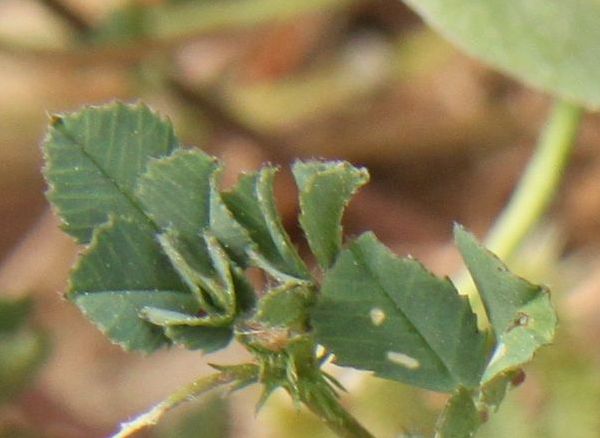
This plant has trefoil grey-green ovate leaves, toothed towards the top. The upper surface is smooth, while the underside is covered in very short fine hairs.
Habitat
Blackdisc Medick is a plant of dry, open areas with well-drained soil. It is often found on disturbed fallow fields, along cultivated field margins, in open olive groves, and beside well-trodden cliff-top paths.
Distribution
Medicago orbicularis is widespread and common throughout the Mediterranean region. Its range extends from souhern Europe down to northern Africa and through the Middle East and into western Asia. The specimens shown here were photographed in the Algarve region of southern Portugal. Elsewhere it is an introduced species - for example in parts of North America, South America, Japan and Australia.
Etymology
The genus name Medicago refers to the region of Iran known as Media, where many kinds of Medick plants were thought to have originated. The specific epithet orbicularis means 'circular' - a reference to the disc-shaped spiralled seed pods - see picture above.
Flowering times
In its native Mediterranean region, Blackdisc Medick can be seen blooming from March to the end of May.

Sue Parker's latest ebook is a revised and enlarged edition of Wild Orchids in The Burren. Full details here...
Buy it for just £5.95 on Amazon...

Please Help Us: If you have found this information interesting and useful, please consider helping to keep First Nature online by making a small donation towards the web hosting and internet costs.
Any donations over and above the essential running costs will help support the conservation work of Plantlife, the Rivers Trust and charitable botanic gardens - as do author royalties and publisher proceeds from books by Pat and Sue.