Ophrys x arachnitiformis
Phylum: Magnoliophyta - Class: Liliopsida - Order: Orchidales - Family: Orchidaceae
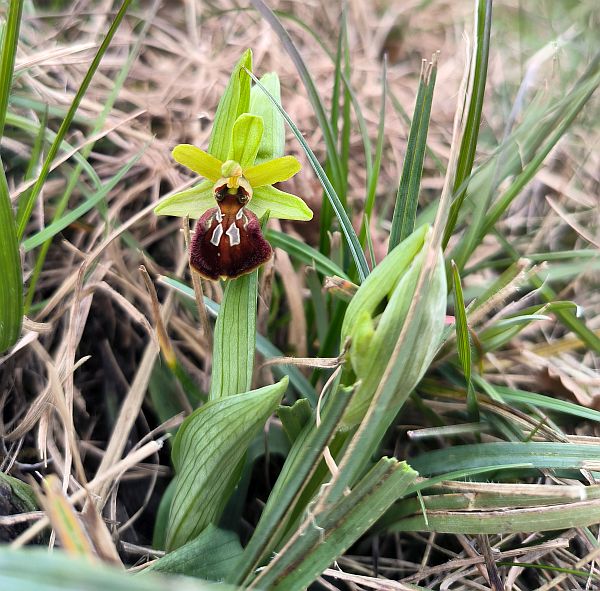
Photograph courtesy Monica and Andrew Rowland
Both the taxonomy and nomenclature of this orchid are much contested and it has been the subject of debate, studies and opinions for many years. It has literally dozens of synonyms of which, in France at least, Ophrys occidentalis is the most commonly used. In early March this orchid flowers in good numbers in the Rhone region.
Description
This orchid grows to between 10 and 30cm in height and each plant carries 4 to 7 large flowers. The sepals are bright green and the petals sometimes almost yellow. The lips of the flowers are particularly distinctive and are large and square with complex speculums which stand out against the dark brown velvety backgrounds.
Distribution
Ophrys x arachnitiformis is centred around southern France and northern Spain.
Habitat
This orchid grows in calcareous soils and tolerates dry-to-moist conditions in open and sunny short grassland.
Flowering times
Late February and early March.
Varieties and Hybrids
This orchid is part of a group of many highly confusing plants with similar-looking flowers. Some studies suggest that it may be a hybrid between Ophrys sphegodes Early Spider Orchid and Ophrys fuciflora Late Spider Orchid.
Reference sources
The World Flora Organisation (WFO) Plant List
Sue Parker (2023) Wild Orchids of Wales - how, when and where to find them; First Nature e-book (Amazon Kindle format)
Henrik AErenlund Pedersen & Niels Faurholdt (2007) Ophrys - The Bee Orchids of Europe; Kew
Pierre Delforge (2005) Orchids of Europe, North Africa and the Middle East; A&C Black


Please Help Us: If you have found this information interesting and useful, please consider helping to keep First Nature online by making a small donation towards the web hosting and internet costs.
Any donations over and above the essential running costs will help support the conservation work of Plantlife, the Rivers Trust and charitable botanic gardens - as do author royalties and publisher proceeds from books by Pat and Sue.