Rubia peregrina - Wild Madder
Phylum: Anthophyta - Class: Equisetopsida - Order: Gentianales - Family: Rubiaceae
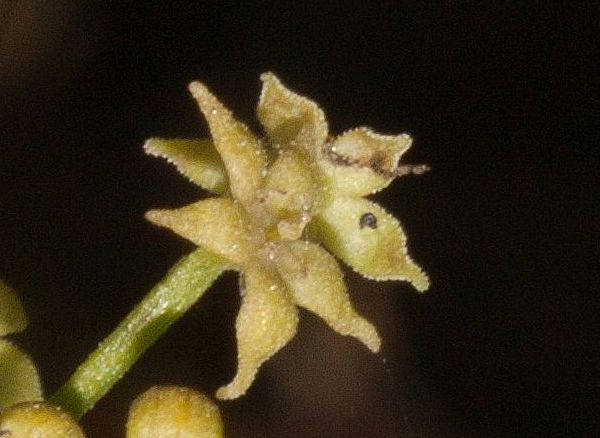
This evergreen perennial member of the bedstraw family is a branching plant that leans for support against other herbs and bushes.
Description
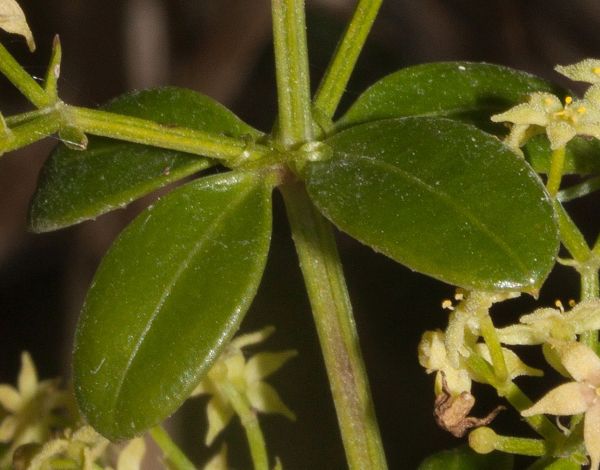
Wild Madder typically grows to a height of 0.5 to 1 metre, but by scrambling up other plants it can sometimes grow to more than 2 metres. The stems are four sided and have sharp ridges, often with tiny backward-facing hooks that help Willd Madder cling to other plants.
The shiny dark-green oval to lanceolate leaves grow in whorls of 4 to 6 around the stems and are typically 3 or 4cm long. There is a central rib which, on the underside, has tiny backward-facing hooks, and leaves usually have tiny, downward-facing prickles at their edges.
The five-petalled creamy-yellow or pale green star-like flowers are typically 4 to 6mm across and have long stalks. The flowers are borne in clusters of typically 5 to 10 and develop at the end of stems and from leaf axils.
Habitat
You will find Wild Madder in rocky coastal areas, scrublands, hedgerows and woodland edges.
Distribution
In Britain Rubia peregrina is largely restricted to southwest England and Wales, where it is most commonly found in coastal areas. Wild Madder is a native wildflower in parts of Western and Southern Europe, and it is most common in Portugal, Spain, France, Italy, Greece, Turkey and the countries of former Yugoslavia. This wildflower is also found in North Africa and the Middle East.
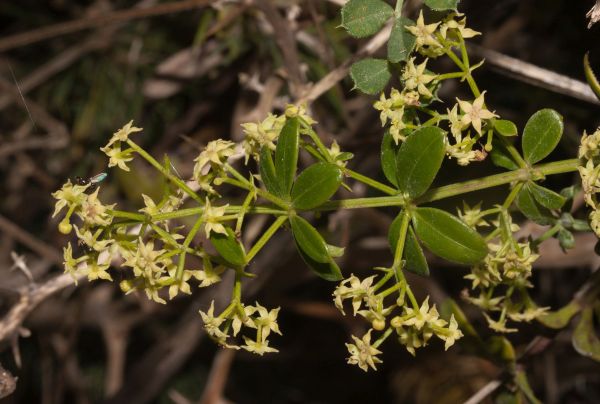
Blooming times
In the UK, Wild Madder flowers between June and August. In Mediterranean countries the flowers can appear as early as April. The flowers are followed by berries which are initially green and turn black as they ripen in late summer. Each berry contains a single seed.
Similar species
There are several other kinds of madder including Field Madder Sherardia arvensis, which has pink or mauve flowers and Common Madder Rubia tinctorium, which has much narrower pale-green leaves.
Etymology
The genus name Rubia comes from the Latin word Ruber, meaning red - a reference to the red dye made from roots of some plants in this genus. The specific epithet peregrina means strange or wandering and may refer to the way these plants travel using other plants for support.
The plants shown on this page were photographed in the Algarve during May.

Sue Parker's latest ebook is a revised and enlarged edition of Wild Orchids in The Burren. Full details here...
Buy it for just £5.95 on Amazon...

Please Help Us: If you have found this information interesting and useful, please consider helping to keep First Nature online by making a small donation towards the web hosting and internet costs.
Any donations over and above the essential running costs will help support the conservation work of Plantlife, the Rivers Trust and charitable botanic gardens - as do author royalties and publisher proceeds from books by Pat and Sue.