Torilis japonica - Upright Hedge Parsley
Phylum: Magnoliophyta - Class: Equisetopsida - Order: Apiales - Family: Apiaceae
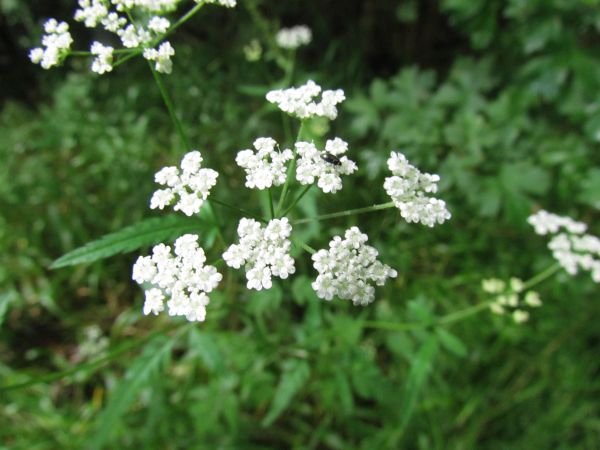
At a casual glance it is easy to mistake this plant for its more common and widespread relative, Cow Parsley. It is sometimes referred to as Erect Hedge Parsley.
Description
By the calendar alone Upright Hedge Parsley, a summer-flowering plant, is readily separated from (spring-flowering) Cow Parsley; however, other umbellifers such as Hemlock also bear many similarities.
Upright Hedge Parsley usually grows to between 0.6 and 1.2m in height. Although relatively thin, the stems are remarkably stiff. This wildflower can be either annual or biennial.
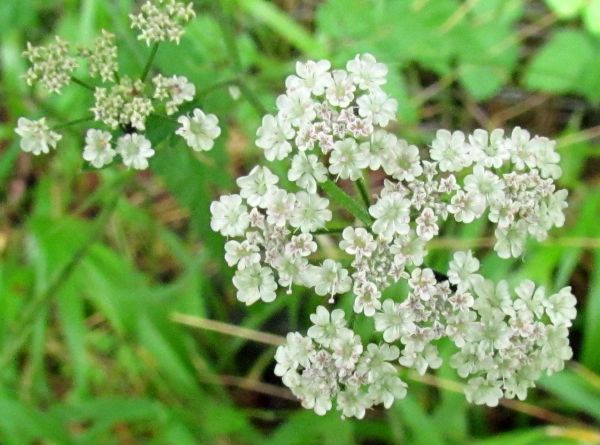
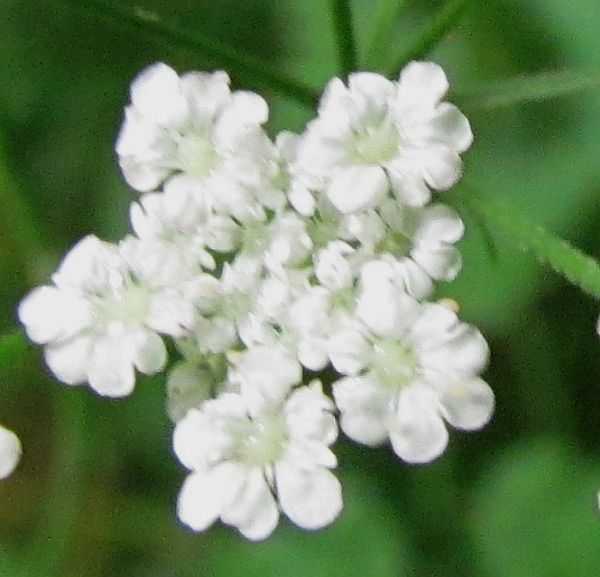
The flattish flower umbels have typically 4 to 9 umbellets. The individual flowers are usually 2 to 3.5mm across. The white or pinkish flowers each have five petals, usually notched, and with slightly longer petals near the outer edges of the umbellets.
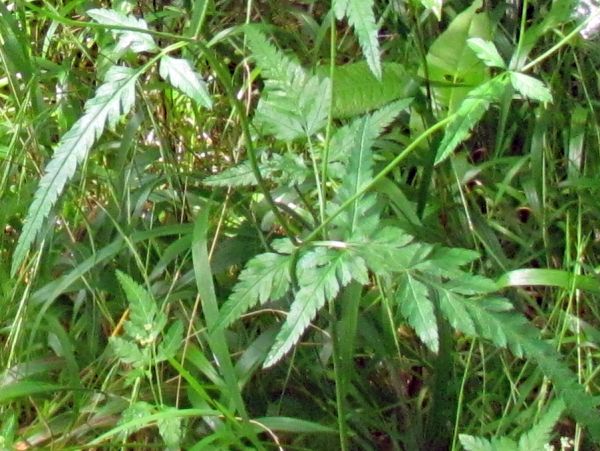
The fern-like hairy leaves of this wildflower are pinate (divided into feathery leaflets). The leaf stalks and the stems of Upright Hedge Parsley are hairy.
The green Fruits of Upright Hedge Parsley are elongated and covered in bristles that catch in animals' fur - a means of distribution. The seed pods gradually turn brown as they ripen in late autumn and winter.
Distribution
This member of the Carrot family (Apiaceae) is widespread across most of Britain, becoming scarcer in the north of Scotland. It is native also to Ireland and mainland Europe as well as Asia and North Africa. In North America, Australia and New Zealand Upright Hedge Parsley is an introduced alien and is considered to be a nuisance invasive weed.
Habitat
Upright Hedge Parsley is found beside hedgerows and on scrubby wasteland, but it is also quite common on woodland edges and beside tracks through woodland.
Blooming Times
Flowering much later than Cow Parsley, Upright Hedge Parsley is usually at its peak in July and August, with some plants still in flower at the end of September in sheltered locations.
Etymology
Torilis, the genus name, seems to be a made up word with no known meaning. The specific epithet japonica implies 'of or from Japan'; however, this species is native to and more common in Europe.
Similar Species
Cow Parsley Anthiscus sylvestris flowers much earlier than Hedge Parsley.
Hemlock Conium maculatum has hollow purple-spotted stems; it is seriously poisonous.
Hogweed Heracleum sphondylium produces its flowers in late spring and summer; the leaves are much larger and only coarsely divided.
The plants shown on this page were photographed in Wales and in France during August.

Sue Parker's latest ebook is a revised and enlarged edition of Wild Orchids in The Burren. Full details here...
Buy it for just £5.95 on Amazon...

Please Help Us: If you have found this information interesting and useful, please consider helping to keep First Nature online by making a small donation towards the web hosting and internet costs.
Any donations over and above the essential running costs will help support the conservation work of Plantlife, the Rivers Trust and charitable botanic gardens - as do author royalties and publisher proceeds from books by Pat and Sue.