Broad-bordered Bee Hawk-moth - Hemaris fuciformis
Phylum: Arthropoda - Class: Insecta - Order: Lepidoptera - Family: Sphingidae
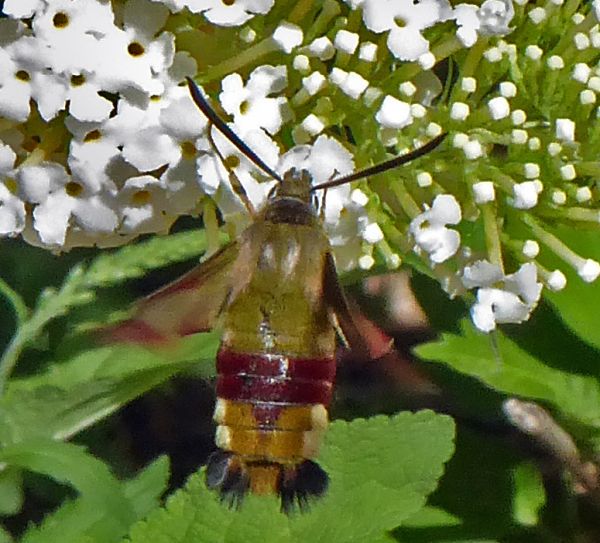
The Broad-bordered Bee Hawk-moth is a day-flying moth species which, like the Hummingbird Hawk-moth, hovers in front of tubular flowers as it uses it proboscis to feed on nectar.
Description
Male and female Broad-bordered Bee Hawk-moths look almost identical. If you see both sexes close up you may notice that the female usually has a somewhat stouter body and slightly shorter and slimmer antennae than the male.
The wingspan ranges between 4.0 and 5.2cm. The wings are transparent and have reddish-brown borders. Both males and females have fuzzy bee-like bodies.
Distribution
In Britain the distribution of the Hummingbird Hawk-moth is mainly restricted to Central and Southern England and some parts of Wales. There are strongholds in East Anglia and Lincolnshire with localised populations along parts of the South Coast of England and notably the New Forest in Hampshire.
This Eurasian moth species is also recorded in temperate parts of Central and Southern mainland Europe, parts of Asia, and Mediterranean-coastal North Africa.
Habitat
These moths favour open sunny places with plenty of nectar-producing flowers. They can be seen feeding on Buddleias in parks and gardens. In the UK and Ireland they are most often seen on deciduous woodland edges, in open woodland rides and on herb-rich scrubland bordering woods. Their main larval foodplants are Honeysuckle, but they sometimes use bedstraws such as Lady's Bedstraw and Heath Bedstraw.
Lifecycle
In the UK, the Broad-bordered Bee Hawk-moth usually produces one brood per year. Females lay their green eggs singly on the undersides of leaves of their larval hostplants, mainly Honeysuckle (Lonicera species) but also bedstraws (Galium species). In typically one to two weeks the eggs hatch and tiny green caterpillars emerge. These larvae feed on the leaves of their hostplant for two to three weeks. Fully grown caterpillars are up to 53mm long, bright green with purplish blotches underneath, and they have a distinctive rear horn. They turn dark purplish-brown before climbing down and spinning cocoons just below the ground or concealed under leaf litter. They overwinter in the pupal form.
Adults emerge from May to July. They fly rapidly on bright sunny days, hovering in front of nectar-rich funnel-shaped flowers such as Honeysuckle, Rhododendron, and Bugle.
Acknowledgements
This page includes pictures kindly contributed by Betty and Tony Rackham.
Studying butterflies and moths...
Excited by rivers and streams? So are we, and we're pretty sure you would find the Winding River Mystery trilogy of action-packed thrillers gripping reading too. Dead Drift, Dead Cert, and Dead End are Pat O'Reilly's latest river-based novels, and now they are available in ebook format. Full details on our website here...
Buy each volume in ebook format for only £2.47 on Amazon... Paperbacks also available on Amazon at £6.95 each. All proceeds go towards keeping the First Nature website online.
Please Help Us: If you have found this information interesting and useful, please consider helping to keep First Nature online by making a small donation towards the web hosting and internet costs.
Any donations over and above the essential running costs will help support the conservation work of Plantlife, the Rivers Trust and charitable botanic gardens - as do author royalties and publisher proceeds from books by Pat and Sue.